

Writing User Stories: Acceptance Criteria & DoD Guide

Writing User Stories

Big release cycles often contain dozens of complex user stories. Some add immediate value, while others tweak existing features. However, decoding ambiguous stories creates our biggest project bottleneck.


Unclear requirements waste precious team hours on constant guessing. You must write clear, testable requirements to keep sprint momentum strong.


Effective user story writing turns big goals into precise execution steps. You need solid acceptance criteria and a clear Definition of Done.

This guide shows you how to decode requirements and structure user stories. You will learn to write testable criteria for clean team handoffs.


Standardizing your user story format reduces team confusion by over 40%. Combining clear narrative templates with step-by-step actions creates a smooth, fast delivery pipeline.

What is User Story Writing?


Writing user stories means defining features clearly from the end-user’s perspective.


During my past change management work, requirement decoding caused constant friction. Our release contained many stories with mixed goals and feature updates. The real problem was poor requirement clarity, not technical skill. Unclear stories made developers guess, delayed testers, and blocked live releases. Standardizing our story format immediately fixed these daily operational headaches.

Writing User Stories
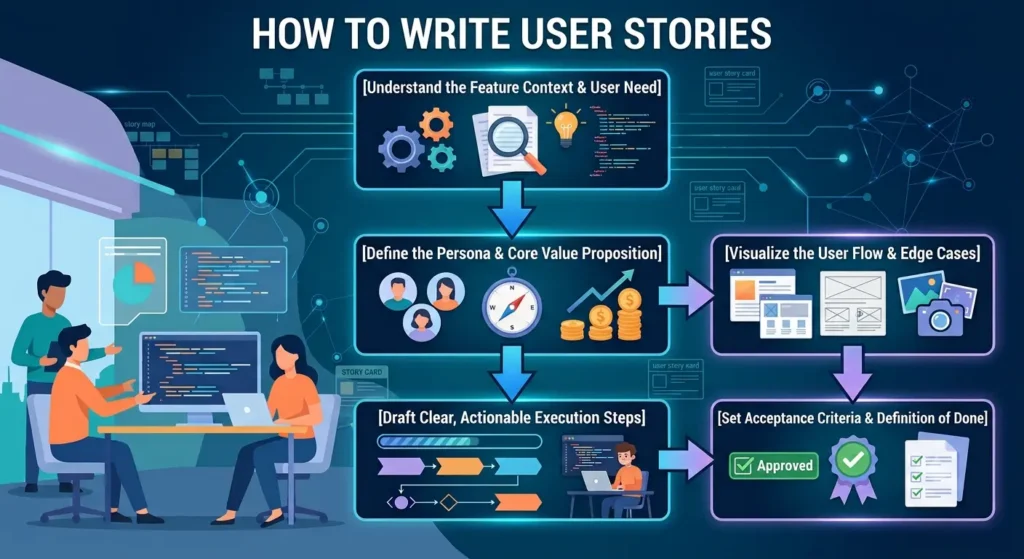
Writing User Stories Process | Gemini

This simple structure organizes your entire workflow from intake to final delivery. A standardized setup gives project leads complete operational control through three main pillars:


  • Removes Requirements Confusion: Everyone reads the exact same scope without any mixed signals.
  • Speeds Up Testing: Clear steps let QA teams test features without constant back-and-forth pings.
  • Eases Live Deployment: Firm completion rules help releases move safely into production.

Turning vague requests into structured stories creates an actionable project roadmap. Clear stories help your team understand impacted users, flows, and checks instantly.

What Are the Steps for Writing User Stories?


Follow these simple steps to give your team exact execution details every time.


Analyze the Core Requirement First


Review incoming requests thoroughly with your key stakeholders before writing anything. Identify target users and align the requested change with your main project goals.


Practice and Map the Functional Changes


Hands-on testing is completely vital for clear documentation. Walk through the live system and test the exact place where changes happen. Experiencing the flow directly helps you write accurate steps based on real usage.

Organize every ticket clearly using these essential structural sections:

  • Persona Role: Identifies the specific user who receives the change.
  • Goal Action: Defines the exact feature or action the user performs.
  • Value Benefit: Explains the core business value or problem solved.
  • Functional Steps: Details the exact step-by-step path to check the feature.
  • Visual Proof: Adds UAT screenshots to guide technical reviews visually.


Use the Standard Agile Story Format


Write your core story using the standard agile structure: “As a [Role], I want [Goal], so that [Benefit].” This keeps your team focused on the user, the feature, and the business value.


Detail the Exact Action Steps


Add explicit, step-by-step instructions directly below your main story text. Document the exact sequence you followed during your own hands-on testing. This step-by-step clarity guides developers and gives testers an instant test script.


Attach Clear UAT Visual Evidence


Capture and attach screenshots if your feature exists in staging or UAT environments. Adding visual proof removes guesswork for technical leads during daily builds.


This simple step-by-step process replaces messy tracking with full operational control. Clear requirements protect your team’s time and ensure smooth sprint delivery.

What Are the Key Benefits of Well-Structured User Stories?


Standardized user story templates directly improve your delivery speed, testing, and release quality.


Operational Metric

Unstructured Notes

Structured User Story Approach

Requirement Clarity

Vague notes causing constant confusion

Standardized “As a… I want… So that…” format

Team Understanding

Delayed sprint starts from endless questions

Fast team alignment and instant clarity

Validation Speed

Slow testing cycles with unclear checks

Step-by-step guides for rapid testing

Deployment Success

High risk of hidden bugs at release

Smooth live deployments backed by UAT proof


  • Drives Absolute Clarity: Pairs high-level goals with exact action steps to stop confusion.
  • Boosts Team Efficiency: Helps developers and designers understand scope fast and start building immediately.
  • Empowers QA Testing: Gives testers clear, repeatable steps to validate features without delay.
  • Supports Safe Deployments: Helps release managers launch updates confidently using verified visual evidence.

Adopting this systematic approach turns messy handoffs into a reliable execution engine. Clear steps and testable criteria keep your delivery pipeline moving fast.


Conclusion 


Mastering user story writing turns requirement gathering into a reliable operational process. Practice functional changes, use standard agile formats, list exact steps, and add visual proof. Doing this removes requirement confusion and helps your team deliver work with confidence.


Explore the latest practical project management guides on ayushwrites.in.

How useful was this post?

Click on a star to rate it!

Average rating 0 / 5. Vote count: 0

No votes so far! Be the first to rate this post.

As you found this post useful...

Follow us on social media!

We are sorry that this post was not useful for you!

Let us improve this post!

Tell us how we can improve this post?

Frequently Asked Questions

How do detailed functional steps prevent sprint delays?

Detailed action steps provide an exact execution roadmap. Your team starts building immediately instead of wasting time asking for basic requirement details.

What sets Acceptance Criteria apart from Definition of Done?

Acceptance Criteria cover feature-specific needs for one story. Definition of Done provides a master checklist applied to every story across the project.

Why should you attach visual proof from UAT environments?

Attaching UAT screenshots gives your team clear visual context. It removes layout confusion and ensures the final feature matches stakeholder expectations.

Who writes user stories during a sprint?

Product Owners and Project Managers usually lead story writing. However, you should involve developers and testers early to confirm technical details.

Thank you for landing on this page and reading my blog. I will be writing more on project management and also cover my life insights as well. Stay tuned and subscribe to my newsletter. 

About Ayush Kumar


Ayush Kumar is a Project Operations professional and writer with experience in project delivery, business operations, and process improvement. Through AyushWrites.in, he shares practical insights on Project Operations, Process Improvement, project management, workflows, and better ways of working.


With a writing journey that began in 2016, Ayush combines clear communication with a practical approach to managing projects and improving processes. His work explores topics such as governance, risk management, change control, workflow optimization, and operational efficiency.  

For more about Ayush and his journey, visit the About page or connect with him on LinkedIn.
Amazing Years

I started my journey back in 2016, but started working officially since 2023. I worked with so many amazing companies and learnt a lot throughout this journey. And I’m still learning new skills and knowledge. 

Thank you for encouraging Me!

Each time you visit this page, you encourage me to perform better and better. So thank you for visiting and getting to know about me!

Project Governance

Project Governance: Establishing Authority and Accountability

Project Governance: Establishing Authority and Accountability In every project, there are some complex situations which present multiple challenges.   These challenges don’t occur because the engineers don’t know how to build, or because the marketing team lacks creativity. It happens...

Read More
SLA and OLA Delivery Timelines

How to Enforce SLA and OLA Delivery Timelines

How to Enforce SLA and OLA Delivery Timelines When you scale a digital product or an enterprise operation, speed can quickly turn into your biggest liability. Moving fast without structural alignment doesn’t mean you’re agile; it usually means your internal...

Read More
Lean Process Operations

Lean Process Operations: Eliminate Non-Value-Added Steps

Lean Process Operations: Eliminate Non-Value-Added Steps Lean operations are one of the most effective ways to drive efficiency and cut unnecessary costs out of your project processes. Money saved is money earned—and that holds completely true for lean workflows. Every...

Read More
Subscribe to Our Newsletter

We don’t spam! Read our privacy policy for more info.

Let's Connect