

How to Use Project Portfolio Management for Scaling ROI

Project Portfolio Management Featured

When managing complex operations, the most dangerous trap isn’t failing to hit a deadline it is letting your team sprint fast in the wrong direction. Delivering a project on time means absolutely nothing if that project shouldn’t have been on your roadmap to begin with.


Think about capital management. You would never risk your entire financial future on one volatile stock; you spread your capital across a balanced portfolio structured specifically for maximum returns.


Your team’s daily schedule requires that exact same discipline. Bandwidth is finite. Without a strict filtering mechanism to prioritize tasks against commercial milestones, you are simply subsidizing chaos and bleeding cash. Reclaiming control over your operational pipeline demands a deliberate approach to resource allocation it is the only way to convert raw hustle into revenue growth.

Project Portfolio Management (PPM) is a centralized management process used to identify, prioritize, authorize, and manage an organization’s mix of projects. By analyzing resource capacity against strategic business goals, PPM ensures companies maximize operational efficiency, balance risk, and allocate capital strictly to high-return initiatives.


What is Project Portfolio Management?


Project Portfolio Management (PPM) is the deliberate process of identifying, sorting, and prioritizing an organization’s mix of projects to manage resources with maximum efficiency. We use this system to bridge the gap between technical operations and executive revenue targets.


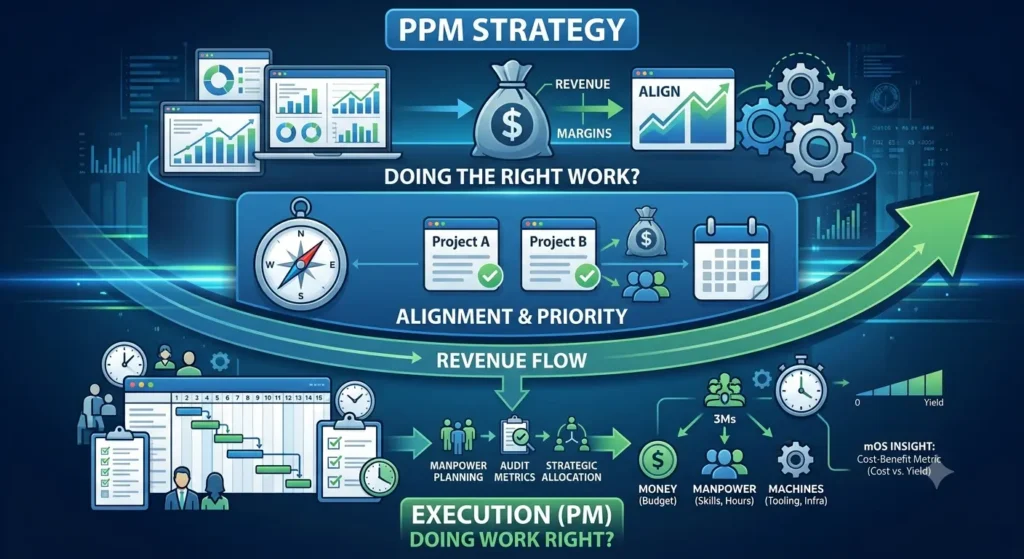
When we analyze resources within our framework, we look at the classic 3M’s:


  • Money: Your actual financial capital and budget constraints.
  • Manpower: The collective hours, skillset, and bandwidth of your team.
  • Machines: Your modern infrastructure stack, from laptops and servers to marketing automation engines and CRM databases.


Your portfolio allocation hinges entirely on a strict balance of cost versus reward. Project Portfolio Management forces us to prioritize projects that offer the maximum strategic return for the least amount of operational drain.

Why does this matter? Because execution without tracking is a direct shortcut to burnout. When we run a business, we cannot treat all projects equally. We must evaluate every single initiative based on its direct contribution to the company’s bottom line.


The Cost-Benefit Metric

Before any project enters our active portfolio, we run a strict operational audit. We calculate the total projected cost (the 3M’s required) against the expected commercial yield or sales pipeline growth. If the execution cost outweighs the velocity of the return, we pause or kill the initiative immediately.

What is the Process to Establish Project Portfolio Management?


We establish our Project Portfolio Management structure through a definitive, five-step execution pipeline built for maximum velocity.


1. Conduct Manpower Planning


Before you look at the work, look at your capacity. We calculate the exact number of total operational hours our team has available per week, stripped of administrative overhead. Fact-check: Teams that skip this step overcommit their bandwidth by an average of 30%, leading to missed deadlines. Know your true baseline capacity first.


2. Audit Existing Project Metrics


Run a deep analysis on every active project. We filter them by three metrics: urgency of business priority, time to completion, and current financial burn rate.


3. Execute Strategic Allocation


Map the audited projects against your manpower baseline. We assign the highest-value, top-priority initiatives to our executive leads and associates based on their specific strengths.


4. Deploy Target Training


If a high-return project requires a specific technical stack or data methodology your team hasn’t mastered, plan and embed target training directly into their schedule. Never let a skill gap derail a high-margin portfolio asset.


5. Identify Asset Requirements


Explicitly list any infrastructure, software licenses, or external tooling (the “Machines”) required to clear the runway for your team before execution kicks off.


The Master PPM Blueprint Matrix


We use this standardized structured data layout to track resource allocation across our entire portfolio.


Project Name

Strategic Priority (H/M/L)

Required Hours

Total Estimated Cost

Expected Revenue Impact

Status (Approve/Hold)

Project Alpha (Checkout Fix)

High

120 hrs

$15,000

+$120k Pipeline Velocity

Approved

Project Beta (Internal Tooling)

Low

200 hrs

$30,000

Minimal Short-term ROI

On Hold

Conclusion


Skipping out on Project Portfolio Management because you feel “too busy fighting daily fires” is a dangerous trap. It might give you the illusion of a hardworking, bustling team in the short term, but it is actually a direct shortcut to misallocated resources, blown budgets, and burned-out talent working on low-value tasks.


Take the extra time upfront to map out your capacity. Audit your active pipeline, run a ruthless cost-benefit analysis on every initiative, and build a single source of truth for your resource distribution.


Frequently Asked Questions

What is the main difference between project management and Project Portfolio Management?

 Project management is purely tactical, focusing on executing a single project’s tasks, timelines, and immediate resources. Project Portfolio Management is high-level and strategic. It evaluates the entire collective pipeline of projects simultaneously to ensure your overall resource allocation aligns perfectly with commercial business goals.

How do we prevent low-value projects from creeping into our active portfolio?

We use a strict gatekeeping mechanism driven by our cost-benefit analysis metric. Before any initiative gains approval, the project sponsor must prove its expected revenue impact against the team capacity it consumes. If the data shows a low strategic yield, we push it to a formal backlog.

How often should an organization review its project portfolio?

We review our portfolio capacity metrics dynamically every month, with major strategic re-alignments happening quarterly. Market demands shift quickly, meaning you cannot set your portfolio in January and ignore it. Regular audits allow us to pivot manpower toward high-performing campaigns instantly.

Can a small team benefit from Project Portfolio Management principles?

Absolutely. PPM is even more critical for small teams because your resource constraints are much tighter. When you only have two or three execution assets, wasting forty hours on a low-priority task stalls your entire growth engine. Defining your priorities from day one protects your limited bandwidth.

Thank you for landing on this page and reading my blog. I will be writing more on project management and also cover my life insights as well. Stay tuned and subscribe to my newsletter. 

About Ayush Kumar

Ayush Kumar is an operational strategist and founder of ayushwrites.in, a platform built for enterprise leaders looking to transform chaotic workflows into high-margin growth engines. Specializing in Project Operations and advanced tech stacks, Ayush cuts through corporate fluff to bridge the gap between high-level strategy and scalable execution.


Through The Foundry, he deconstructs real-world business stories and case studies, revealing the exact frameworks behind successful enterprise scaling.


Originally from the “Land of the Ganga,” Ayush infuses his business strategies with human-centric life insights gathered from global travel. Want to scale your operations without the chaos?


Connect with Ayush on LinkedIn: In/AayushKnack
Amazing Years

I started my journey back in 2016, but started working officially since 2023. I worked with so many amazing companies and learnt a lot throughout this journey. And I’m still learning new skills and knowledge. 

Thank you for encouraging Me!

Each time you visit this page, you encourage me to perform better and better. So thank you for visiting and getting to know about me!

Project Governance

Project Governance: Establishing Authority and Accountability

Project Governance: Establishing Authority and Accountability There is a distinct point in every complex project where things can easily fall apart.   It usually doesn’t happen because the engineers don’t know how to build, or because the marketing team lacks...

Read More
Project Portfolio Management Featured

How to Use Project Portfolio Management for Scaling ROI

How to Use Project Portfolio Management for Scaling ROI When managing complex operations, the most dangerous trap isn’t failing to hit a deadline it is letting your team sprint fast in the wrong direction. Delivering a project on time means...

Read More
SLA and OLA Delivery Timelines

How to Enforce SLA and OLA Delivery Timelines

How to Enforce SLA and OLA Delivery Timelines When managing complex operations, the most dangerous trap isn’t failing to hit a deadline it is letting your team sprint fast in the wrong direction. Delivering a technical asset on time means...

Read More