

Why I Focus on Project Documentation When I Take Charge

Project Documentation

Early in my career, I used to rely entirely on my memory to manage new projects. That turned out to be a massive mistake. 


When a project has dozens of moving parts and hidden guidelines, it is impossible to track everything accurately. After watching critical tasks slip through the cracks, I knew that my approach had to change immediately. That is when I shifted my focus entirely to project documentation.


Instead of guessing, I started compiling every single detail from the day-one kickoff to the final date of submission into one bulletproof system. This simple shift completely transformed how I execute every initiative, and in this guide, I will show you exactly how to build a framework that keeps your own projects perfectly on track.


What is Project Documentation?


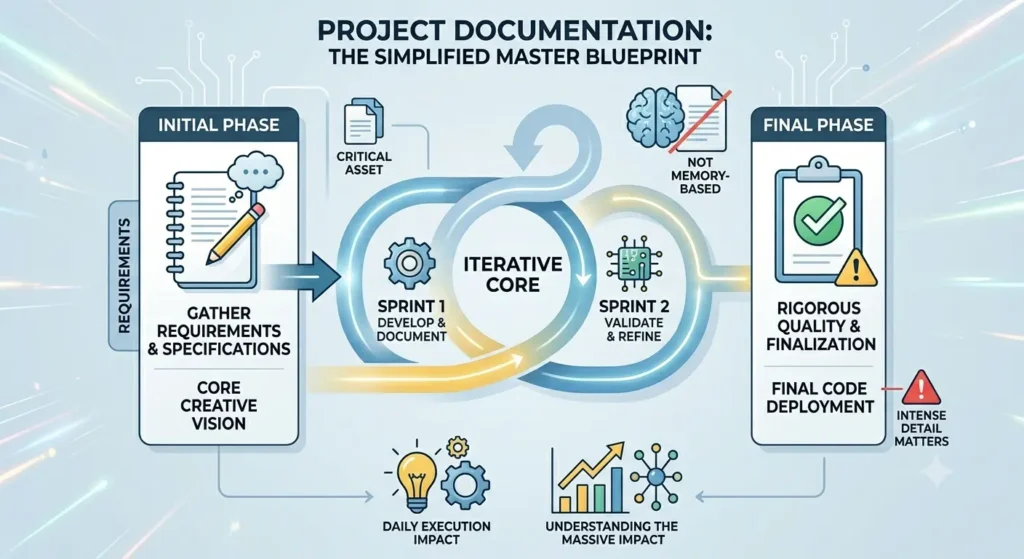
Project documentation is the master blueprint that contains all the rules, regulations, and guidelines for your project processes. It maps out every single process involved from start to finish. In an agile environment, this means breaking a massive project down into manageable sub-parts and detailing exactly how to execute each one.


Every single sub-part and micro-task comes with its own unique requirements. For instance, the initial phase of a software project focuses entirely on gathering client requirements, brainstorming ideas, and locking down design specifications. 


However, the final phase before launch pivots completely toward rigorous quality checks to ensure every single feature works flawlessly. This is where intense attention to detail becomes critical, as a single missed guideline can disrupt the entire project timeline.


Mastering these shifting requirements throughout a project lifecycle is virtually impossible if you are just relying on memory. Now that we have defined what it is, the next step is understanding the massive impact it has on your daily execution.


Let’s look at exactly why this asset is so critical to your operational success.

Why is Project Documentation Important?


There is a reason why top-tier project managers refuse to kick off an initiative without a clear paper trail: project documentation is absolutely vital to your operational survival. Instead of forcing you to wait until release week to cross your fingers and pray that your project meets the bar, it builds quality control directly into every single stage of the lifecycle.


When you formalize your processes, you protect your project from unnecessary friction. Here is exactly why investing time into your documentation pays off:


  • Saves Critical Time: It acts as an external brain for your team, allowing anyone to instantly recall fractional details and micro-guidelines without pausing execution to ask questions.
  • Protects the Project Budget: By catching misalignments early, you save valuable financial resources and avoid the costly, late-stage redesigns that happen when teams guess their way through a project.
  • Reduces Costly Errors: Mapping out exact expectations from day one drastically minimizes the margin for error, meaning you waste far fewer company resources on fixing mistakes.
  • Consistently Meets Client Expectations: When guidelines are clear and traceable, your final deliverables naturally align with what the client asked for, ensuring you hit your targets right on time.


Now that you understand the key benefits of keeping a paper trail, you are probably wondering how to actually structure one for your own team.


Let’s look at a project documentation blueprint you can copy and paste for your next initiative.

Sample Project Documentation 


To help you get started immediately, here is a plug-and-play template that you can copy, paste, and adapt for your next initiative. This structure ensures that no critical details slip through the cracks, from the initial kickoff to the final hand-off.


[Project Name]: Master Documentation Blueprint


1. Project Overview & Objectives


  • Project Description: A brief, 2-3 sentence summary of what this project is and what it aims to achieve.
  • Primary Goal: The main measurable outcome (e.g., Launch the new mobile checkout flow with a < 3-second page load time).
  • Key Stakeholders: Names and roles of the Project Lead, Client Contacts, and Main Contributors.


2. Phase 1: Requirements & Design (The Foundation)


  • Client Specifications: Bullet points listing the explicit requirements provided by the client or product team.
  • Design Guidelines: Links to wireframes, mood boards, UI layouts, and brand compliance rules.
  • Idea Log: A dedicated space to capture brainstorming notes and approved concepts before execution begins.


3. Phase 2: Execution & Agile Sub-Parts (The Core)


  • Sub-Part A: [Name of Module/Task]
    • Micro-Guidelines: Specific operational steps required to complete this task.
    • Technical Requirements: Code standards, specific tools to use, or data inputs needed.
  • Sub-Part B: [Name of Module/Task]
    • Micro-Guidelines: Specific operational steps required to complete this task.
    • Technical Requirements: Dependency notes (e.g., “Cannot start until Sub-Part A is approved”).


4. Phase 3: Quality Assurance & Pre-Launch Bars (The Gatekeeper)


  • Pre-Release Checklist: The exact criteria that must be met before anything goes live (e.g., cross-browser testing, security audits).
  • Definition of Done (DoD): The explicit quality standard that proves a functionality is truly finished, not just “mostly” working.
  • Error Log: A tracking table for bugs discovered during testing and the steps taken to fix them.


5. Phase 4: Final Submission & Sign-off


  • Deployment/Hand-off Protocol: Step-by-step instructions on how the final assets or code are delivered to the client.
  • Final Review Date: [Insert Date]
  • Client Sign-off Status: [Pending / Approved]

Now that you have a structural framework to work with, maintaining this level of clarity might still leave you with a few tactical questions about daily execution.


Conclusion


Skipping out on project documentation because you feel “too busy to write paperwork” is a dangerous trap. It might give you the illusion of speed in the first week, but it is actually a direct shortcut to missed guidelines, bleeding budgets, and chaotic miscommunications right before deadline day.


Take the extra time upfront to map out your process. Centralize your sub-parts, define your quality standards, and build a single source of truth for your team. Treat your documentation as your ultimate operational insurance policy, and you will watch your execution speed and project success rate skyrocket


Frequently Asked Questions

How detailed should project documentation be for small sub-parts?

It should be detailed enough that a team member can execute the task without needing to pause and ask for clarification. You don’t need to write a novel—just list the explicit micro-guidelines, required tools, and the exact “definition of done” for that specific sub-part so nothing slips through the cracks.

When is the best time to start writing project documentation?

The process should begin on day one during the initial kickoff phase. Documentation is a living asset, meaning you lock down the client requirements and design specifications first, and then continuously update the agile sub-parts and quality checklists as the project progresses toward final submission.

Does creating documentation slow down the project kickoff?

While it requires a small investment of time upfront, it actually accelerates the overall project lifecycle. Taking the time to document your processes prevents the costly errors, late-stage redesigns, and endless email threads that inevitably happen when teams try to guess their way through complex requirements.

Tab Title Can project documentation change once the initiative has started?

Absolutely. Effective documentation is agile. While your primary objectives and final submission goals should remain steady, the internal micro-guidelines and sub-parts should be updated whenever client feedback pivots or new technical requirements arise during the execution phase.

Thank you for landing on this page and reading my blog. I will be writing more on project management and also cover my life insights as well. Stay tuned and subscribe to my newsletter. 

About Ayush Kumar

Ayush Kumar is an operational strategist and founder of ayushwrites.in, a platform built for enterprise leaders looking to transform chaotic workflows into high-margin growth engines. Specializing in Project Operations and advanced tech stacks, Ayush cuts through corporate fluff to bridge the gap between high-level strategy and scalable execution.


Through The Foundry, he deconstructs real-world business stories and case studies, revealing the exact frameworks behind successful enterprise scaling.


Originally from the “Land of the Ganga,” Ayush infuses his business strategies with human-centric life insights gathered from global travel. Want to scale your operations without the chaos?


Connect with Ayush on LinkedIn: In/AayushKnack
Amazing Years

I started my journey back in 2016, but started working officially since 2023. I worked with so many amazing companies and learnt a lot throughout this journey. And I’m still learning new skills and knowledge. 

Thank you for encouraging Me!

Each time you visit this page, you encourage me to perform better and better. So thank you for visiting and getting to know about me!