


How to Use Project Capacity Planning to Stop Team Burnout Fast

Project Capacity Planning

Scaling a high-output operation is one of the most rewarding challenges in business, especially when your team consistently turns ambitious project roadmaps into seamless market launches. To keep that delivery engine firing at peak efficiency, leaders need full visibility into their operational bandwidth.


Aligning work allocation with real-world capacity keeps velocity high, execution smooth, and project quality consistent. Mapping bandwidth upfront gives your team the clear runway needed to execute without friction.


Project Capacity Planning matches incoming project demand with actual operational bandwidth, ensuring every initiative is fully resourced and delivered on target.

Why Project Capacity Planning Powers Growth


Project capacity planning provides the structural clarity needed to balance ambition with execution. It ensures your strategic roadmap is backed by realistic operational capability.


A successful capacity strategy focuses on three core elements:

  • Predictive Workload Buffers: Accounting for standard operational factors—such as training, planned leave, and internal alignment—ensures your project schedules remain resilient and achievable.
  • Focused Execution Time: Structuring schedules to protect dedicated project hours gives your team the breathing room required for high-quality, deep work.
  • Strategic Talent Expansion: Data-driven capacity forecasting highlights exactly when and where to expand your team, allowing for smooth recruitment and onboarding ahead of growth cycles.

Strategic Resource Balance: Sustained high performance relies on balanced utilization. Aiming for an 80% baseline allocation allows teams to deliver top-tier results while maintaining the agility needed to adapt to new opportunities.

Project Capacity Planning
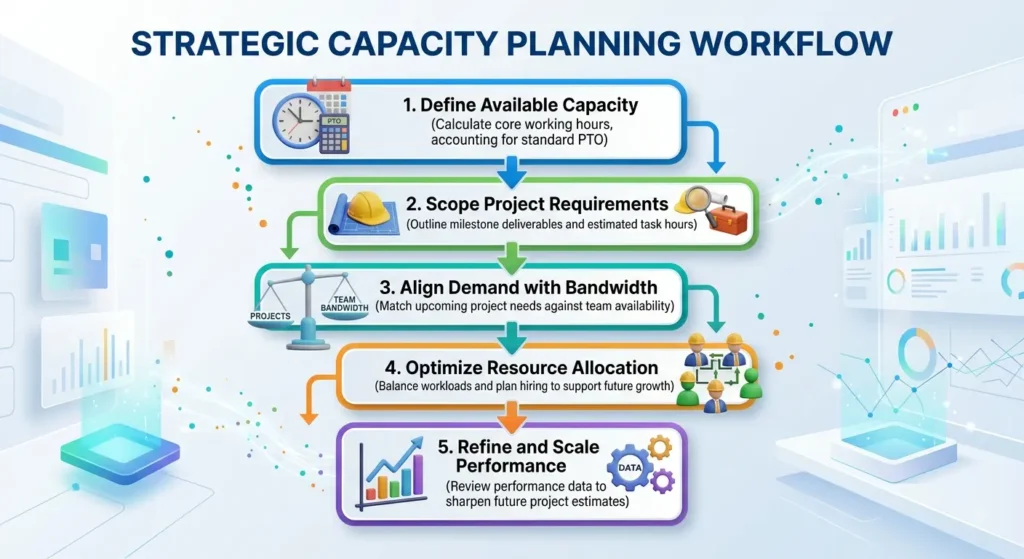
Project Capacity Planning Workflow Process

5 Steps to Implement Project Capacity Planning


We use this straightforward execution path to balance workloads, optimize performance, and keep delivery schedules moving forward smoothly.


1. Define True Working Capacity


Establish your baseline by calculating total available hours, factoring in standard holidays, approved time off, and operational activities to determine your net working bandwidth.


2. Scope Deliverables with Technical Precision


Work closely with key leads to map out incoming initiatives into clear task hours. Defining technical requirements upfront builds confidence in delivery timelines.


3. Align Priorities Early


Compare your upcoming project requirements against available bandwidth. Having forward visibility into your schedule allows you to prioritize high-value initiatives and balance workload distribution gracefully.


4. Enable Growth Through Informed Hiring


Use consistent utilization trends to plan your recruitment strategy. Clear data empowers leadership to expand team headcount proactively as business demand grows.


5. Continuously Refine Execution Cycles


Review planned versus actual hours at the close of every milestone. This continuous feedback loop sharpens future estimates and keeps your operations running efficiently.


Core Operational Benefits


  • Supports Sustainable High Performance: Keeps team members energized and engaged by maintaining balanced, manageable workloads.
  • Ensures Consistent Delivery: Clear scheduling metrics ensure projects stay on track and meet quality standards every time.
  • Streamlines Hiring Strategy: Provides clear timelines for recruiting talent, ensuring seamless integration into active workflows.
  • Maximizes Value Creation: Keeps team bandwidth focused on core priorities, driving maximum return on your operational investments.

Conclusion


Building a strong capacity planning process is one of the most effective ways to drive operational excellence. When you give your team the right structural support and accurate bandwidth visibility, you unlock higher output, stronger engagement, and predictable execution.


Set your organization up for success by establishing clear bandwidth baselines, planning for operational buffers, and using real-time data to guide your growth. Invest in your capacity planning early, and your operations will scale smoothly and efficiently.

Frequently Asked Questions

What is the main difference between resource planning and project capacity planning?

Resource planning is tactical and short-term, focusing on allocating specific team members to immediate tasks. Project capacity planning is strategic and macro-focused, analyzing total team availability and upcoming business demand to ensure the organization has the long-term capability to achieve its goals.

How do you account for operational buffers in capacity forecasting?

Deduct a standard percentage (typically 5% to 10%) for general operational activities, learning, and team alignment directly from total gross hours before scheduling major project deliverables.

What is the ideal target utilization rate for an operations team?

 The optimal target utilization rate is between 75% and 85%. Operating within this window maintains high team productivity while preserving flexibility for administrative tasks, cross-departmental collaboration, and strategic adjustments.

When should capacity planning trigger a new hiring request?

 Initiate hiring workflows when capacity forecasts show team utilization will consistently exceed 85% over upcoming quarters. This provides ample lead time to recruit, hire, and onboard talent smoothly before new project phases begin.

Thank you for landing on this page and reading my blog. I will be writing more on project management and also cover my life insights as well. Stay tuned and subscribe to my newsletter. 

About Ayush Kumar

Ayush Kumar is an operational strategist and founder of ayushwrites.in, a platform built for enterprise leaders looking to transform chaotic workflows into high-margin growth engines. Specializing in Project Operations and advanced tech stacks, Ayush cuts through corporate fluff to bridge the gap between high-level strategy and scalable execution.


Through The Foundry, he deconstructs real-world business stories and case studies, revealing the exact frameworks behind successful enterprise scaling.


Originally from the “Land of the Ganga,” Ayush infuses his business strategies with human-centric life insights gathered from global travel. Want to scale your operations without the chaos?


Connect with Ayush on LinkedIn: In/AayushKnack
Amazing Years

I started my journey back in 2016, but started working officially since 2023. I worked with so many amazing companies and learnt a lot throughout this journey. And I’m still learning new skills and knowledge. 

Thank you for encouraging Me!

Each time you visit this page, you encourage me to perform better and better. So thank you for visiting and getting to know about me!

Project Governance

Project Governance: Establishing Authority and Accountability

Project Governance: Establishing Authority and Accountability There is a distinct point in every complex project where things can easily fall apart.   It usually doesn’t happen because the engineers don’t know how to build, or because the marketing team lacks...

Read More
Project Portfolio Management Featured

How to Use Project Portfolio Management for Scaling ROI

How to Use Project Portfolio Management for Scaling ROI When managing complex operations, the most dangerous trap isn’t failing to hit a deadline it is letting your team sprint fast in the wrong direction. Delivering a project on time means...

Read More
SLA and OLA Delivery Timelines

How to Enforce SLA and OLA Delivery Timelines

How to Enforce SLA and OLA Delivery Timelines When managing complex operations, the most dangerous trap isn’t failing to hit a deadline it is letting your team sprint fast in the wrong direction. Delivering a technical asset on time means...

Read More