

Lean Process Operations: Eliminate Non-Value-Added Steps

Lean Process Operations

Lean operations are one of the most effective ways to drive efficiency and cut unnecessary costs out of your project processes. Money saved is money earned—and that holds completely true for lean workflows. Every dollar you trim from a client project protects your margin while lowering their total cost. When you consistently deliver faster results at a lower cost, it builds deep trust and opens the door for long-term project extensions.


In this blog, we’ll dive into how to spot hidden waste in your systems, eliminate non-value-added steps, and build a lean operating model that delivers maximum value with minimum friction.

What is Lean Process Operations?


A Lean process operations model focuses on maximizing value while systematically eliminating waste, whether that waste is unnecessary approvals, redundant data entry, or waiting time between tasks. Instead of pushing work through bloated systems, Lean operations optimize flow so every step adds direct value to the end deliverable.


The real-world data proves this isn’t just management theory.


According to case study insights from the Lean Enterprise Institute, heavy-equipment manufacturer Vermeer overhauled its dealer fulfillment by shifting from traditional bulk batch ordering to a lean replenishment model. 

In doing so, they drastically accelerated delivery speeds for their top-selling equipment while unlocking far better cash flow across their entire distribution network.

Lean Process Operations - Steps
Lean Process Operations Steps

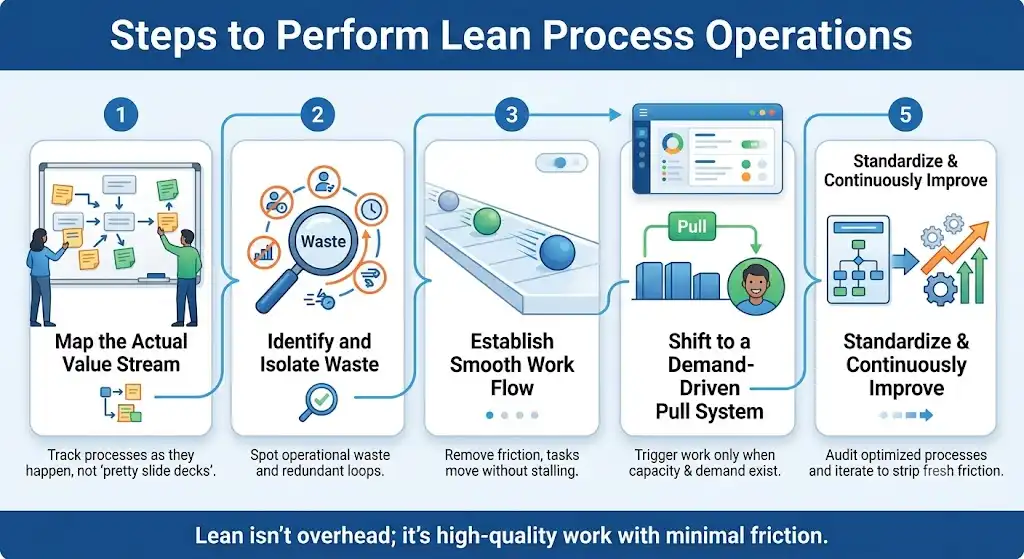
Steps to Perform Lean Process Operations


Project managers (including me) usually roll their eyes when they hear the word “framework.”


Most step-by-step guides feel like rigid, bureaucratic laws designed to eat up your time. But true Lean steps are lean by nature. They are a flexible, super-practical sequence designed to fix broken workflows fast. And the best part is that you don’t need a massive, unreadable Excel sheet to run them.


Here’s how to do it step-by-step:

  • Map the Actual Value Stream: Track your project process exactly as it happens in reality, not how it looks on a pretty slide deck.
  • Identify and Isolate Waste: Spot the 8 types of operational waste—from unnecessary review loops and redundant handoffs to idle waiting times between tasks.
  • Establish Smooth Work Flow: Remove friction points so tasks move continuously from one stage to the next without sitting stalled in a queue.
  • Shift to a Demand-Driven Pull System: Trigger work only when there is active capacity and clear demand, preventing team burnout and Work-In-Progress (WIP) buildup.
  • Standardize and Continuously Improve: Lock in the newly optimized process as your baseline, then continually audit it to strip out fresh friction as you scale.

When you strip away the corporate buzzwords, Lean isn’t about adding extra management overhead; it’s simply about getting high-quality work out the door with as little friction as possible.


Sample Lean Operations Process


To see how this works in practice, let’s look at a typical project operations scenario: handling client deliverable sign-offs.


The Traditional (Bloated) Process


  1. The specialist completes a draft and emails it to the Project Manager.
  2. The PM reviews it, leaves comments in a separate document, and emails it back.
  3. The specialist updates the draft and re-uploads it to a shared folder.
  4. The PM routes it via email to two internal directors for approval.
  5. The draft sits in email inboxes for three days waiting for review.
  6. The client finally receives the file, requests minor revisions, and the multi-step email chain repeats from step one.
  • Total Lead Time: 8–10 Days
  • Value-Added Work Time: 4 Hours
  • Primary Waste: Over-processing, excessive waiting time, and multi-channel communication friction.

The Lean (Optimized) Process


  1. Single Source of Truth: The specialist works directly inside a collaborative workspace (like Jira, Asana, or Notion) where the deliverable status is visible in real-time.
  2. Defined Approval Thresholds: Low-risk deliverables bypass multi-tier director reviews entirely based on pre-set quality criteria.
  3. Trigger-Based Hand-off: Completing a task automatically notifies the client with an embedded review link, eliminating manual PM email relaying.
  4. Contextual Feedback: The client drops comments directly on the asset, and the specialist resolves them in real-time.
  • Total Lead Time: 1–2 Days
  • Value-Added Work Time: 3.5 Hours
  • Primary Gain: 80% reduction in total lead time with zero extra management overhead.

Conclusion


Lean operations aren’t about cutting corners or imposing rigid corporate rules on your team. They are about respecting your team’s time, protecting your project margins, and delivering maximum value to your clients without unnecessary drag.

When you systematically strip out bloated approval chains, idle waiting times, and redundant manual steps, you build a system that scales naturally. Start small: pick one broken workflow in your current project cycle, identify the hidden waste, and make it lean.

Frequently Asked Questions

What is the main goal of Lean operations in project management?

The core goal of Lean process operations is to maximize value delivered to the client while systematically identifying and eliminating waste, such as unnecessary review loops, idle waiting times, and manual status tracking from project workflows.

How does Lean operations differ from traditional Six Sigma?

While both focus on process optimization, Lean primarily targets speed, flow, and the elimination of non-value-added waste. Six Sigma focuses heavily on reducing process variation and defect rates through detailed statistical analysis. Many modern teams combine both into a Lean Six Sigma framework.

Does implementing Lean operations require new software or tools?

No. Lean is an operational mindset and methodology, not a software package. You can apply Lean principles using your existing task management stack by simply streamlining your hand-off rules, clarifying approval thresholds, and cutting out redundant communication steps.

How do I measure if my Lean process improvements are actually working?

Track your Process Cycle Efficiency (PCE) and total lead time. If the time it takes for a task to move from start to final delivery decreases without a drop in quality or work standards, your Lean optimizations are successfully removing operational drag.

Thank you for landing on this page and reading my blog. I will be writing more on project management and also cover my life insights as well. Stay tuned and subscribe to my newsletter. 

About Ayush Kumar

Ayush Kumar is an operational strategist and founder of ayushwrites.in, a platform built for enterprise leaders looking to transform chaotic workflows into high-margin growth engines. Specializing in Project Operations and advanced tech stacks, Ayush cuts through corporate fluff to bridge the gap between high-level strategy and scalable execution.


Through The Foundry, he deconstructs real-world business stories and case studies, revealing the exact frameworks behind successful enterprise scaling.


Originally from the “Land of the Ganga,” Ayush infuses his business strategies with human-centric life insights gathered from global travel. Want to scale your operations without the chaos?


Connect with Ayush on LinkedIn: In/AayushKnack
Amazing Years

I started my journey back in 2016, but started working officially since 2023. I worked with so many amazing companies and learnt a lot throughout this journey. And I’m still learning new skills and knowledge. 

Thank you for encouraging Me!

Each time you visit this page, you encourage me to perform better and better. So thank you for visiting and getting to know about me!

Project Governance

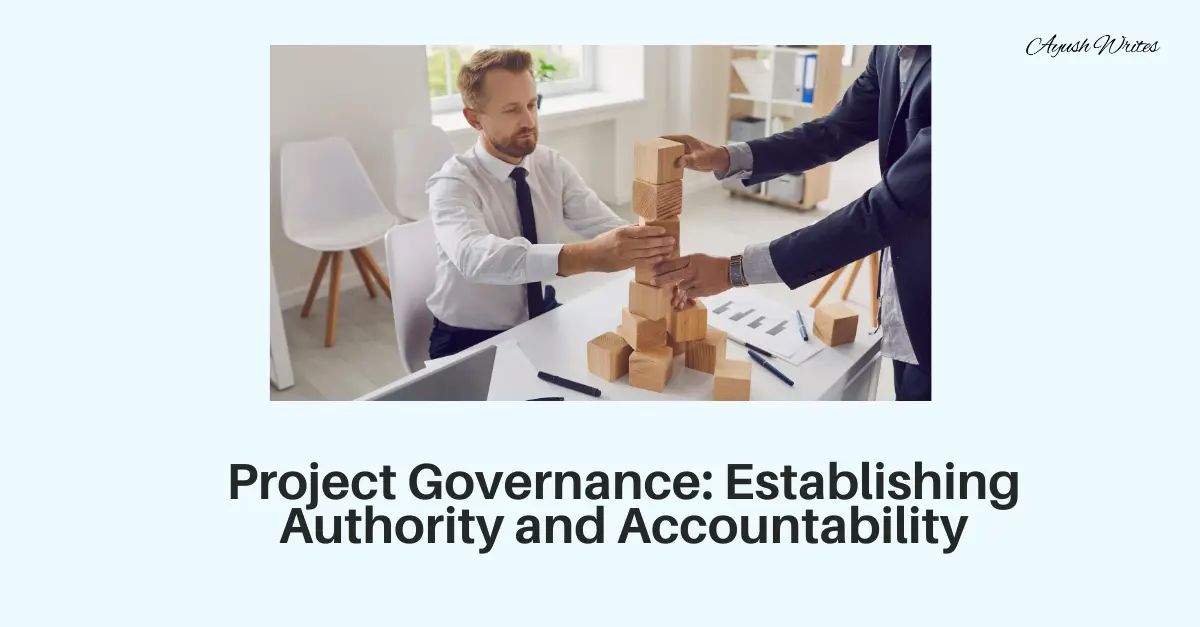
Project Governance: Establishing Authority and Accountability

Project Governance: Establishing Authority and Accountability There is a distinct point in every complex project where things can easily fall apart.   It usually doesn’t happen because the engineers don’t know how to build, or because the marketing team lacks...

Read More
Project Portfolio Management Featured

How to Use Project Portfolio Management for Scaling ROI

How to Use Project Portfolio Management for Scaling ROI When managing complex operations, the most dangerous trap isn’t failing to hit a deadline it is letting your team sprint fast in the wrong direction. Delivering a project on time means...

Read More
SLA and OLA Delivery Timelines

How to Enforce SLA and OLA Delivery Timelines

How to Enforce SLA and OLA Delivery Timelines When managing complex operations, the most dangerous trap isn’t failing to hit a deadline it is letting your team sprint fast in the wrong direction. Delivering a technical asset on time means...

Read More