

Project Charter: The Only Document That Saves Your Budget

Project Charter, Project Management

Whenever I get brought in to consult on a new enterprise project, do you know what the very first thing I ask for is?


The Project Charter.


But let me take you back a few years. Early on in my career, the term “Project Charter” sounded like complete corporate fluff to me. It sounded like some overly formal political charter or a dusty compliance rulebook that executives signed just to check a box.


I used to think, “Why waste time writing a document about the project when we could just start building the project?”


I was wrong.


As I grew in my career and looked under the hood of hundreds of companies, I realized something painful: Most projects don’t fail at the finish line. They fail on Day 1 because of a lack of alignment. The Project Charter isn’t boring paperwork. It is the single most important document for any project yo

u will ever run.

What is a Project Charter, Really?


If you look up the textbook definition, it will tell you that a project charter is a formal document that authorizes the existence of a project and provides the project manager with the authority to apply organizational resources.


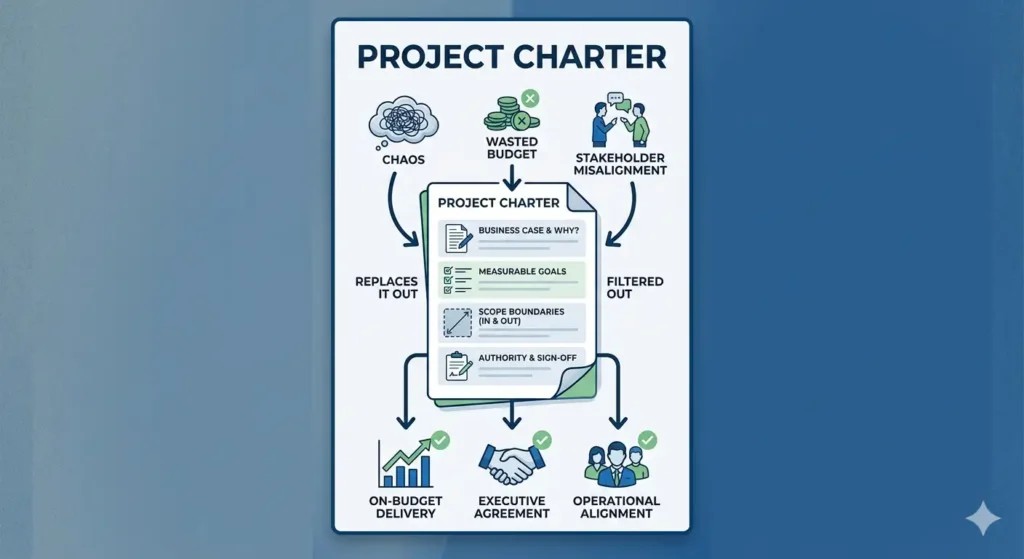
But we aren’t here for textbook definitions. In the real world, a project charter is your Project Constitution. It is a short, punchy, 1-to-2-page document that gets everyone—from the executive holding the checkbook to the engineer writing the code singing from the exact same songbook.


If it’s longer than two pages, you’re doing it wrong. It needs to clearly lock in three core pillars:


  • The “Why” and “What”: The exact, numbers-driven business case and the specific problems you are solving.
  • The Scope Boundaries: What is strictly included and more importantly, what is not included.
  • The Power Framework: Who is running the show and who has the final sign-off power over the money.
Project Charter Format

How a 1-Page Document Saves Thousands in Wasted Budget


Let’s talk about the money. Because at the end of the day, your operational efficiency dictates your profit margins.


When projects go over budget, people blame the developers, the marketers, or the technology stack. But usually, the budget didn’t leak because of bad work—it leaked because of Scope Creep and Misalignment.


Here is exactly how a tight project charter protects your cash flow:


1. It Forces the Hard Conversations Upfront (Before You Spend a Dime)


Have you ever started a project based on a vague email? Halfway through, Executive A thinks the system should do X, and Executive B thinks it should do Y. Suddenly, your team is tearing down work they just spent three weeks building.


The Fix: The charter forces all key stakeholders to sit at the table and agree on the exact success metrics before execution begins. If they can’t agree on Page 1, they shouldn’t be spending a dollar of the budget yet.


2. It Establishes a “Scope Shield”


The biggest budget killer in enterprise projects is the infamous: “Oh, while you’re at it, can you add this feature too?” Every time someone adds a “small feature,” your timeline stretches and your budget evaporates.


The Fix: A great charter lists what is Out of Scope. When a stakeholder tries to sneak in a new requirement mid-project, you don’t have to argue. You simply point to the signed charter and say, “That’s a great idea for Phase 2, but according to our signed Day 1 charter, it’s out of scope for this budget.”


3. It Minimizes “Decision Paralysis” and Bottlenecks


Projects stall and stalled projects burn cash through labor costs when no one knows who has the authority to make a final call.

The Fix: The charter explicitly names the Project Manager and details their exact level of authority over resources and spending. It eliminates political finger-pointing and keeps the project moving at a high velocity.

Sample Project Charter Format


You don’t need complex software to build a high-impact charter. You just need a structured, clean format that forces clarity. Here is the exact template I use to lock in alignment before execution:


1. Project Overview & Authorization

  • Project Name: Enterprise CRM Data Sync Optimization

  • Project Sponsor: Executive VP of Operations

  • Project Manager: Ayush Kumar

  • Authorized Budget: $45,000

2. The Business Case (The “Why”)

Problem Statement: Our marketing automation platform and sales CRM currently sync data on a delayed 12-hour cycle. This delay results in sales reps contacting leads with outdated behavioral data, leading to an estimated 14% drop in potential trial-to-paid conversions.


Expected Business Value: Transitioning to a near-real-time data sync trigger will allow sales reps to act within 15 minutes of user engagement, capturing high-intent leads when they are hottest.

3. Measurable Objectives (The “What”)


To measure success accurately, we are tracking three core technical KPIs:

  • KPI 1: Reduce data sync latency from 12 hours to less than 10 minutes.

  • KPI 2: Achieve 99.9% data consistency between the production database and CRM profiles.

  • KPI 3: Complete the implementation and full data audit within a strict 6-week sprint window.

4. Scope Boundaries (The Limits)


In Scope (What We Are Doing)Out of Scope (What We Are NOT Doing)
Rewiring the webhook architecture between CRM and Marketing stack.Migrating legacy customer data older than 24 months.
Building automated deduplication scripts for active contacts.Designing new custom email marketing templates.
Conducting load testing for up to 50,000 daily sync events.Integrating third-party ERP accounting systems.


5. Resource Authority & Approval Sign-Off


By signing below, stakeholders agree to the scope outlined above and authorize the Project Manager to allocate internal engineering hours up to the approved budget limit.

  • Sponsor Signature: _______________________ Date: _______________

  • Project Manager Signature: ___________________ Date: _______________


Conclusion


At the end of the day, operational excellence isn’t about working harder—it’s about removing friction before it slows your team down.


Skipping the project charter phase because you are “too busy to write paperwork” is a trap. It feels like speed, but it’s actually a shortcut to massive technical debt, missed deadlines, and bleeding budgets.


Take the extra day. Gather your key stakeholders. Lock down your scope, define your metrics, and get that signature. Treat your project charter as your operational insurance policy, and you will watch your project success rate skyrocket.

Frequently Asked Questions

Who is responsible for creating the project charter?

While the Project Sponsor (the executive funding the project) technically issues the charter, it is almost always co-written by the Project Manager. The PM gets their hands dirty doing the research, while the Sponsor provides the final approval and authority.

Can a project charter be changed once it is signed?

Very rarely, and only through a formal Change Control Process. If you change the charter constantly, it loses its power as a baseline framework. If a massive market shift occurs that forces a pivot, the original charter must be formally amended and re-signed by the executive sponsor.

What is the main difference between a project charter and a project plan?

A Project Charter is a high-level document that answers Why the project exists, What the boundaries are, and Who is in charge. A Project Plan is a granular document created after the charter is signed that details How the work will get done, including individual tasks, daily schedules, and Gantt charts.

Thank you for landing on this page and reading my blog. I will be writing more on project management and also cover my life insights as well. Stay tuned and subscribe to my newsletter. 

About Ayush Kumar

Ayush Kumar is an operational strategist and founder of ayushwrites.in, a platform built for enterprise leaders looking to transform chaotic workflows into high-margin growth engines. Specializing in Project Operations and advanced tech stacks, Ayush cuts through corporate fluff to bridge the gap between high-level strategy and scalable execution.


Through The Foundry, he deconstructs real-world business stories and case studies, revealing the exact frameworks behind successful enterprise scaling.


Originally from the “Land of the Ganga,” Ayush infuses his business strategies with human-centric life insights gathered from global travel. Want to scale your operations without the chaos?

Connect with Ayush on LinkedIn: In/AayushKnack
Amazing Years

I started my journey back in 2016. I worked with so many amazing companies and learnt a lot throughout this journey. And I’m still learning new skills and knowledge. 

Thank you for encouraging Me!

Each time you visit this page, you encourage me to perform better and better. So thank you for visiting and getting to know about me!