

How to Implement Project Regulatory Compliance in Your Workflows?

Project Regulatory Compliance

Many times a high-stakes project derails at the final governance stage because a minor compliance issue slipped through the cracks. 


It usually happens when in tight delivery timelines and pressure of resource allocation, the project managers rely on the surface level checklists which fail to protect your deliverables. 


According to a study by the Project Management Institute (PMI) on organizational governance and risk, firms with robust compliance frameworks achieve a 92% project success rate compared to just 63% for organizations with unstructured oversight. 


This brings us to one important question: How do you actually manage ongoing compliance? The answers are right here in this guide.


Project regulatory compliance is that process which helps ensure that every phase of a project adheres to internal policies, regulatory mandates, and structural guidelines outlined in project charters. 


Applying these compliance strategies through structured random sampling eliminates hidden gaps, safeguards profit margins, and drives predictable delivery outcomes.


Read on to discover how to build an active mechanism that protects your deliverables, eliminates compliance drift, and scales operational execution across enterprise teams.


Leveraging intelligent automation for random sampling and document parsing reduces compliance overhead by up to 35%, allowing governance teams to pivot from reactive firefighting to predictive risk mitigation.

What is Project Regulatory Compliance?


Project regulatory compliance is a process which involves systematic auditing and adherence management of the projects. This is a different process than a traditional review method that only looks at compliance at the very end of a project lifecycle. 

It focuses on real-time verification and doesn’t wait for the last hour updates. 


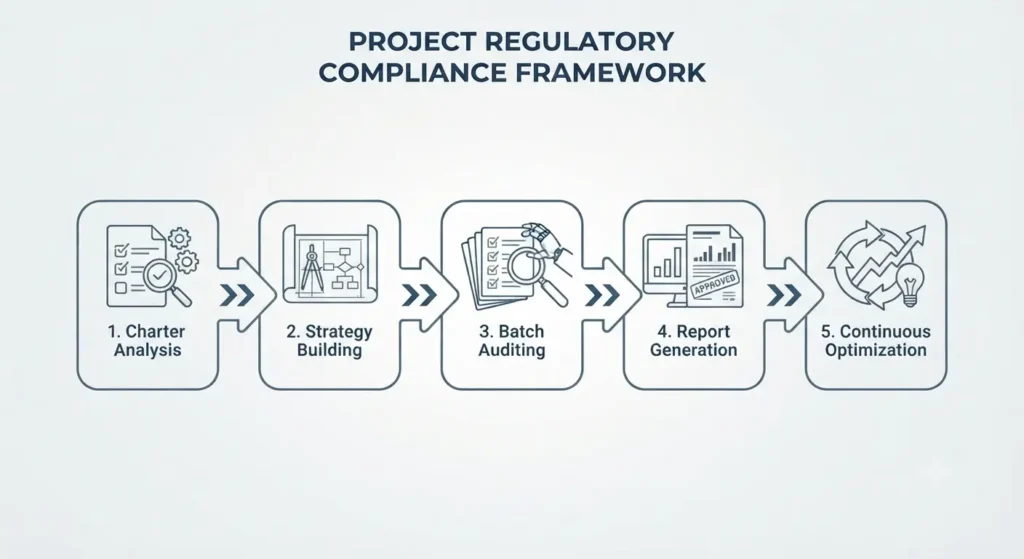
Here is the process that the project regulatory compliance framework follows:


Charter Analysis ──► Strategy Building ──► Batch Auditing ──► Report Generation ──► Continuous Optimization


  • Real-Time Deviation Mitigation: It helps to mitigate deviations in real-time before they escalate into costly project-halting compliance breaches.
  • Resource Preservation: It saves valuable organizational resources by catching non-compliance early through targeted random sampling.
  • Governance Alignment: It directly supports the successful achievement of project goals by ensuring all outputs match planned governance standards.

The project regulatory compliance framework transforms compliance from an administrative bottleneck into a seamless engine for operational excellence. This ensures that every phase of execution remains tightly bound to regulatory expectations.

Project Regulatory Compliance Process
Project Regulatory Compliance Framework Process

Steps to Perform the Project Regulatory Compliance Process


We got our basics right and now let’s see how the step works. The project regulatory compliance framework requires a methodical, step-by-step sequence that bridges initial planning with continuous monitoring.

  • Step 1: Analyse project charter, gather all rules and regulations –  In this step, you need to examine the project charter and baseline documentation to compile every governing policy, legal constraint, and internal standard required for the initiative’s success.
  • Step 2: Build audit strategy document – In this step, you need to build a strategy document defining the scope, frequency, and methodology of reviews, outlining how random sampling and checkpoints will be applied across various project phases.
  • Step 3: Start auditing batches – This step involves continuous batch-based audits to test active deliverables and workflows against the predefined strategy document.
  • Step 4: Give reports – This step delivers clear status reports to project stakeholders, highlighting gaps, variances, and immediate corrective actions.
  • Step 5: Closeout procedures – The final step ensures complete documentation archiving, final regulatory sign-offs, and lessons learned integration for future project lifecycles.

The steps mentioned above are the continuous cycle of verification and improvement. It is an important process that helps to deliver values in project and ensuring the continuity on a right path. 

Key Benefits of Project Regulatory Compliance


A strict compliance helps to maintain quality control, protect the resources and avoid misuse. It helps to maintain efficient flow of operations throughout the lifecycle of a project. 


Performance Goal

Legacy Approach

Streamlined Approach

Audit Speed

Manual, end-of-cycle reviews (Weeks)

Automated batch sampling (Real-time)

Resource Allocation

High reactionary overhead

Optimized preventive allocation

Risk Focus

Post-violation penalties

Preemptive deviation mitigation

Return on Investment

Unpredictable / Cost sink

Measurable resource preservation


  • Accelerated Metrics & Performance: Reduces the time spent preparing for compliance reviews by maintaining audit-ready documentation throughout the project lifecycle.
  • Protection & Risk Mitigation: Shields the organization from unforeseen legal, financial, and operational penalties through rigorous real-time monitoring.
  • Quality Control Standards: Enforces strict adherence to project charter specifications, ensuring uniform deliverable quality across all operational batches.
  • Scalability & Expansion: Enables teams to scale project complexity without a linear increase in administrative oversight or compliance risk.

And that’s not all of it. The best part is that project regulatory compliance acts as a replacement to unpredictable dependencies and relies on a more standard and structured process of compliance.


Conclusion


Regulatory Compliance Framework helps you move ahead in projects, tackle the huddles and roadblockers easily. This not only brings effective project management but also helps save costs! The better the resource management, the better will be an effective PM.


And this blog is just a part of what makes a better project manager capabilities.


Ready to refine your delivery strategy further? Explore our specialized project and operations strategy guides on ayushwrites.in to elevate your management practices today. 

How useful was this post?

Click on a star to rate it!

Average rating 4.2 / 5. Vote count: 5

No votes so far! Be the first to rate this post.

As you found this post useful...

Follow us on social media!

We are sorry that this post was not useful for you!

Let us improve this post!

Tell us how we can improve this post?

Frequently Asked Questions

What triggers a project regulatory compliance audit?

Audits are typically triggered by crossing critical delivery milestones, transitioning into high-risk regulatory phases, or hitting randomized schedule intervals baked directly into your audit strategy document. This prevents teams from waiting until the end of a lifecycle to find hidden liabilities.

When should the compliance strategy document be created?


It should be mapped out immediately following the project charter analysis during the initial setup phase. Building it early ensures that compliance parameters, legal constraints, and governance standards are embedded into workflows before active execution begins

How are implementation risks mitigated during batch auditing?

By relying on targeted random sampling and real-time deviation tracking rather than waiting for massive end-of-cycle reviews. This allows project managers to catch minor process errors or resource bottlenecks early, before they compound into project-halting compliance breaches.

What is the typical ROI timeframe for streamlined compliance?

Organizations usually see a measurable return on investment within the very first completed project lifecycle. The ROI is driven primarily by reduced audit preparation hours, optimized resource allocation, and the elimination of costly non-compliance penalties.

Thank you for landing on this page and reading my blog. I will be writing more on project management and also cover my life insights as well. Stay tuned and subscribe to my newsletter. 

About Ayush Kumar


Ayush Kumar is a Project Operations professional and writer with experience in project delivery, business operations, and process improvement. Through AyushWrites.in, he shares practical insights on Project Operations, Process Improvement, project management, workflows, and better ways of working.


With a writing journey that began in 2016, Ayush combines clear communication with a practical approach to managing projects and improving processes. His work explores topics such as governance, risk management, change control, workflow optimization, and operational efficiency.  

For more about Ayush and his journey, visit the About page or connect with him on LinkedIn.
Amazing Years

I started my journey back in 2016, but started working officially since 2023. I worked with so many amazing companies and learnt a lot throughout this journey. And I’m still learning new skills and knowledge. 

Thank you for encouraging Me!

Each time you visit this page, you encourage me to perform better and better. So thank you for visiting and getting to know about me!

Project Governance

Project Governance: Establishing Authority and Accountability

Project Governance: Establishing Authority and Accountability In every project, there are some complex situations which present multiple challenges.   These challenges don’t occur because the engineers don’t know how to build, or because the marketing team lacks creativity. It happens...

Read More
SLA and OLA Delivery Timelines

How to Enforce SLA and OLA Delivery Timelines

How to Enforce SLA and OLA Delivery Timelines When you scale a digital product or an enterprise operation, speed can quickly turn into your biggest liability. Moving fast without structural alignment doesn’t mean you’re agile; it usually means your internal...

Read More
Lean Process Operations

Lean Process Operations: Eliminate Non-Value-Added Steps

Lean Process Operations: Eliminate Non-Value-Added Steps Lean operations are one of the most effective ways to drive efficiency and cut unnecessary costs out of your project processes. Money saved is money earned—and that holds completely true for lean workflows. Every...

Read More
Subscribe to Our Newsletter

We don’t spam! Read our privacy policy for more info.

Let's Connect