

Why You Need Ethics & Behaviour Courses Nobody Mentions

Ethics & Behaviour Courses

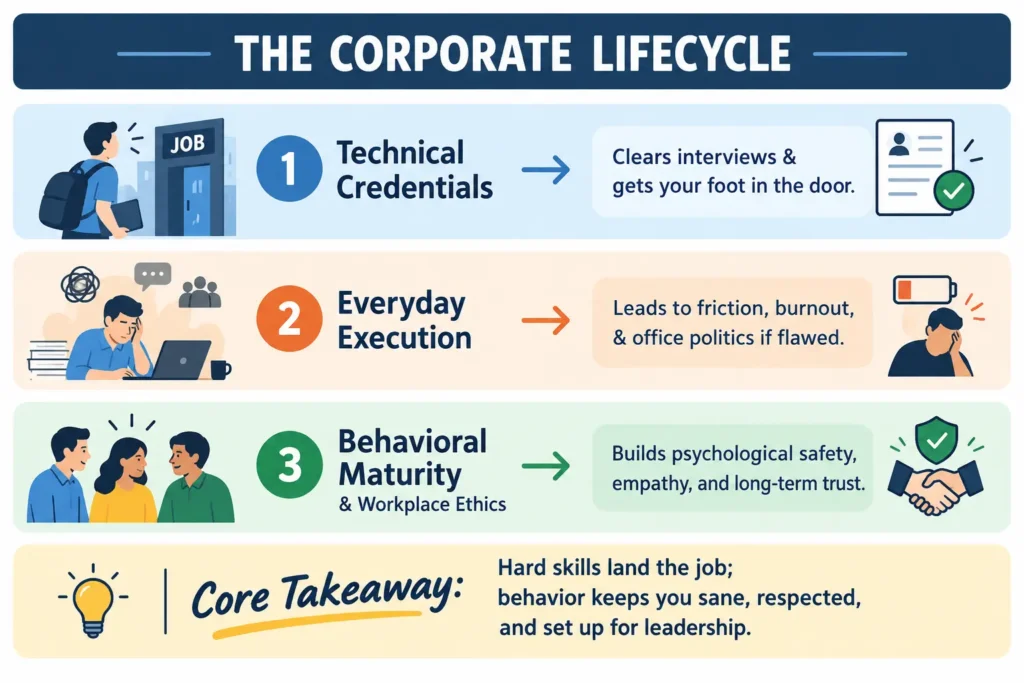
Let’s be honest for a second. We spend years learning syntax, grinding through technical frameworks, and chasing certifications just to look good on paper. But the moment you land a desk in a modern corporate office, you realize none of that saves you from the daily workplace friction.


It’s never about the code or the deliverables crashing. It’s the passive-aggressive Slack pings, the ego wars during sprint reviews, the awkward silence when someone takes credit for your work, and the absolute lack of emotional intelligence in high-pressure crunch times.


College and technical bootcamps give you the hard skills to clear an interview. But they don’t teach you how to survive hallway politics, how to give feedback without sounding arrogant, or how to become the teammate people actually enjoy working with.


Why are Ethics and Behaviour Courses Important?


Think about a high-performing project team where everyone is a technical genius, yet the ecosystem is entirely broken. Deadlines are met, but emails reek of defensive undertones. Cross-functional syncs turn into silent blame games where nobody wants to take ownership of an edge-case failure. 


People talk at each other instead of listening, and constructive feedback is treated like a personal attack. Over time, burnout skyrockets, good people quietly exit, and the team culture decays into a toxic loop of isolation and survival mode. That is what happens when hard skills outrun human capability.


This is precisely why intentional focus on ethics and behavior matters so much:

  • Protects Psychological Safety: Technical frameworks mean nothing if employees are terrified to speak up about bugs or roadblocks due to fear of ridicule. Behavioral maturity builds a safe space where honesty thrives.
  • Reduces Invisible Operational Drag: Miscommunication, ego clashes, and office politics waste thousands of hours of collective productivity. Clear behavioral standards streamline collaboration.
  • Builds Long-Term Career Capital: Anyone can learn syntax, but emotional intelligence, integrity, and behavioral reliability are rare traits that turn individual contributors into trusted, sought-after leaders.

I’ve put together a curated list of free and accessible courses focusing on the raw, unspoken side of corporate life: behavior, transparency, and ethics. If you want to fix how you operate in your team, start here.

Category 1: Effective Team Contribution & Collaboration


In most offices here, teamwork often feels like a silent tug-of-war where everyone is just guarding their own KPIs. True collaboration means knowing how to bridge those gaps without stepping on toes or losing your mind.


  • Effective Collaboration & Teamwork Skills for Professionals (LearnKartS / Coursera)
    • What it addresses: How to work seamlessly with diverse teams, build trust with stakeholders, and contribute effectively as an individual contributor.
    • Access on Coursera
  • Teamwork Skills: Communicating Effectively in Groups (University of Colorado Boulder / Coursera)
    • What it addresses: Group development dynamics, structured decision-making, and diffusing interpersonal friction within project teams.
    • Access on Coursera

Category 2: Problem-Solving & Execution Mastery


When things go south on a project, the default reaction is usually panic, frantic finger-pointing, or defensive email trails. Real problem-solving starts when you strip away the emotional drama and focus on structured execution.

  • Effective Problem-Solving and Decision-Making (University of California, Irvine / Coursera)
    • What it addresses: Moving past surface-level obstacles, mitigating personal biases, and building structured operational solutions.
    • Access on Coursera
  • Problem-Solving Skills (Logical Operations / Coursera)
    • What it addresses: Analytical approaches to corporate roadblocks, creative solution generation, and cross-functional barrier handling.
    • Access on Coursera
Ethics & Behaviour Courses Importance
Ethics & Behaviour Course Importance

Category 3: Becoming an Admired Teammate & Building Like-mindedness


Nobody likes working with the office genius who leaves a trail of bruised egos everywhere they go. Being an admired teammate comes down to emotional balance, psychological safety, and building genuine professional rapport.


  • Empathy and Emotional Intelligence at Work (Coursera)
    • What it addresses: Cultivating self-awareness, deep empathy, and shared psychological safety that makes you a trusted, grounded colleague.
    • Access on Coursera
  • Building Professional Relationships (Coursera)
    • What it addresses: Fostering mutual rapport, building strategic alignment, and cultivating professional connections.
    • Access on Coursera
  • Building Professional Relationships (LinkedIn Learning)
    • What it addresses: Strengthening rapport, alignment, and network loyalty (Note: Requires a LinkedIn Learning subscription or free trial).
    • Access on LinkedIn Learning

Category 4: Communication Transparency, Clarity & Gratitude

Vague updates, hidden agendas, and an inability to say a simple “thank you” or “good job” are what slowly turn a decent team toxic. Clear, transparent communication builds trust from the ground up.

  • Improving Communication Skills (University of Pennsylvania / Coursera)
    • What it addresses: Active listening, structural clarity, and transparent messaging to prevent miscommunications across lines.
    • Access on Coursera
  • The Science of Well-Being (Yale University / Coursera)
    • What it addresses: Habit formation, positive psychological reframing, and structured gratitude practices to drive a constructive individual mindset.
    • Access on Coursera

Category 5: Behavioral Maturity, Ethics & Compliance

Professional maturity isn’t just about closing tickets on time. It’s about personal accountability, respecting boundaries, and upholding basic ethical standards so the entire workplace stays safe and respectful.

  • Workplace Ethics and Professionalism (LearnKartS / Coursera)
    • What it addresses: Institutional integrity, personal accountability, and transparent workplace behavior to minimize friction.
    • Access on Coursera
  • POSH Certification Course (Keka Academy)
    • What it addresses: Vital legal frameworks, professional boundaries, and behavioral standards required for safety and mutual respect in modern workplaces.
    • Access on Keka Academy

Guidelines to Becoming a Better Professional


Courses give you the framework, but daily execution defines who you are. If you want to evolve past the average corporate noise, keep these principles in your back pocket:

  • Over-communicate context, not just status: When handling tasks, don’t just say “done” or “blocked.” Give clear context so your peers understand the why behind your updates. Transparency kills office politics.
  • Practice radical accountability: If a project or deliverable misses the mark due to an oversight on your part, own it immediately without crafting excuses. True professionals look for solutions, not scapegoats.
  • Master the art of calm feedback: When things get heated in a review or a meeting, take a breath before reacting. Critique the process or the code, never the person sitting across from you.
  • Make gratitude a habit: A simple acknowledgment of someone else’s help or a quiet “thanks for sorting this out” goes a long way in building deep, long-lasting professional capital.

At the end of the day, professional growth isn’t a destination you reach by collecting badges or hoarding certificates; it’s a continuous, deliberate practice of self-awareness. When you choose clarity over chaos and empathy over ego, you stop merely surviving the corporate grind and start shaping a healthier, more predictable environment for everyone around you. 


Final Thoughts


Your hard skills get your foot in the door, but your behavior is what keeps you there and earns you genuine respect. Take some time to invest in the human side of your career. Have you picked up any behavioral courses or habits that changed how you deal with office dynamics? Drop a note below and let’s talk.

Frequently Asked Questions

Are these ethics and behavior courses completely free to access?

Most of the curated courses (like Coursera) offer a “Free Audit” option where you can access all learning materials and videos without paying for the certificate. Select options like Keka Academy are also free.

Why do technical professionals need behavioral courses?

While hard skills get you hired or help you write code, technical expertise alone cannot resolve cross-functional friction, ego clashes, or poor communication. Behavioral maturity is what prevents team burnout and drives leadership growth.

How long do these courses typically take to complete?

Most of these foundational courses are structured for flexibility, requiring anywhere from 2 to 5 hours total, easily manageable over a couple of weekends.

Will adding these soft skill courses help with career promotions?

Yes. Promotions to senior or leadership roles rely heavily on emotional intelligence, stakeholder management, and conflict resolution areas directly covered by behavioral and ethics frameworks.

Do I need prior management experience to take these courses?

Not at all. These courses are specifically targeted at individual contributors, developers, and analysts who want to improve their daily collaboration and personal workplace effectiveness.

Thank you for landing on this page and reading my blog. I will be writing more on project management and also cover my life insights as well. Stay tuned and subscribe to my newsletter. 

About Ayush Kumar


Ayush Kumar is a Project Operations professional and writer with experience in project delivery, business operations, and process improvement. Through AyushWrites.in, he shares practical insights on Project Operations, Process Improvement, project management, workflows, and better ways of working.


With a writing journey that began in 2016, Ayush combines clear communication with a practical approach to managing projects and improving processes. His work explores topics such as governance, risk management, change control, workflow optimization, and operational efficiency.  

For more about Ayush and his journey, visit the About page or connect with him on LinkedIn.
Amazing Years

I started my journey back in 2016, but started working officially since 2023. I worked with so many amazing companies and learnt a lot throughout this journey. And I’m still learning new skills and knowledge. 

Thank you for encouraging Me!

Each time you visit this page, you encourage me to perform better and better. So thank you for visiting and getting to know about me!

Project Governance

Project Governance: Establishing Authority and Accountability

Project Governance: Establishing Authority and Accountability In every project, there are some complex situations which present multiple challenges.   These challenges don’t occur because the engineers don’t know how to build, or because the marketing team lacks creativity. It happens...

Read More
SLA and OLA Delivery Timelines

How to Enforce SLA and OLA Delivery Timelines

How to Enforce SLA and OLA Delivery Timelines When you scale a digital product or an enterprise operation, speed can quickly turn into your biggest liability. Moving fast without structural alignment doesn’t mean you’re agile; it usually means your internal...

Read More
Lean Process Operations

Lean Process Operations: Eliminate Non-Value-Added Steps

Lean Process Operations: Eliminate Non-Value-Added Steps Lean operations are one of the most effective ways to drive efficiency and cut unnecessary costs out of your project processes. Money saved is money earned—and that holds completely true for lean workflows. Every...

Read More
Subscribe to Our Newsletter

We don’t spam! Read our privacy policy for more info.

Let's Connect