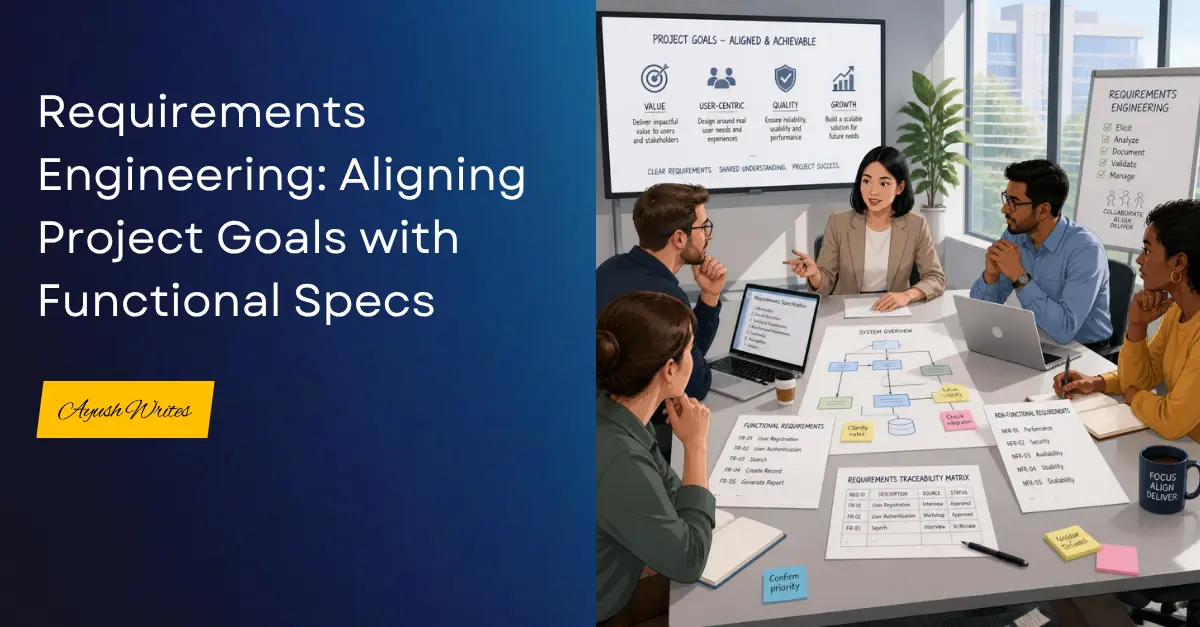


Requirements Engineering: Aligning Project Goals with Functional Specs

Requirements Engineering

Why do so many projects derail before they even cross the finish line? Usually, it is because expectations were never clearly defined from day one. That is where requirements engineering comes into play.


While the term sounds more technical, it isn’t. It is actually the core operational process that keeps modern project management grounded, whether you are deploying software or managing internal business operations.


It is less about traditional engineering and more about establishing a rigorous, systematic framework that acts as your project’s single source of truth. Without it, you are just guessing at what stakeholders want.


Let’s break down how to master this foundational process to translate complex business needs into precise, actionable functional specs. But before we do that, let’s understand what requirements engineering actually is.


What is Requirements Engineering?


Requirements engineering is the systematic process of gathering business or client requirements. In this context, business requirements refer to projects internal to the organization, while client requirements involve capturing the specific needs of external stakeholders.


This process centers on clarity, addressing the project scope, goals, expected outcomes, and tangible deliverables.


You might wonder: If the project charter and documentation already cover scope and details, why did we cover them first?


The project charter outlines high-level boundaries and authorization, while general documentation records overall components. Requirements engineering, however, goes deeper: it is the active process of eliciting, collating, and shaping raw inputs into a structured set of project requirements.

Steps to Perform Requirement Engineering


The requirements engineering process is neither complex nor bloated. In fact, getting this right early on is the single best safeguard against scope creep, saving massive amounts of time and budget down the line.


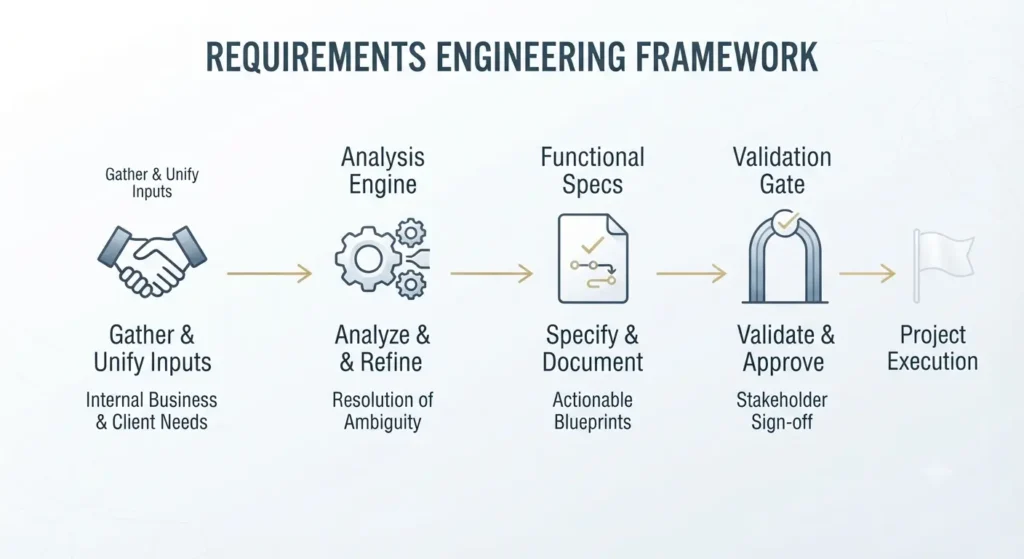
It all begins with establishing consistent communication loops and actively seeking alignment across all stakeholders. To move from raw stakeholder ideas to concrete operational execution, the process follows a structured, multi-stage workflow:


  • Stakeholder Elicitation & Information Gathering: This is where the process starts. You collect raw inputs, constraints, and expectations from all involved parties, whether internal teams or external clients. Rather than just asking what they want, you dig into why they need it to uncover hidden operational bottlenecks.
  • Analysis & Conflict Resolution: Once inputs are gathered, you will inevitably find overlapping, competing, or contradictory demands. This step involves analyzing the data, filtering out unfeasible ideas, and negotiating trade-offs to ensure stakeholder alignment before moving forward.
  • Specification & Documentation: Here, you translate those raw, negotiated conversations into structured, formal requirements. This means turning unstructured thoughts into clear functional specs, user stories, or business process blueprints that the execution team can actually build against.
  • Validation & Sign-Off: The final step before execution is verification. You take the documented specs back to the stakeholders to confirm that what has been written accurately reflects their original goals. Securing formal sign-off here ensures everyone is anchored to the exact same definition of success.

By following this systematic sequence, you bridge the gap between high-level strategy and daily execution, ensuring that every operational move you make is directly tied back to the core project goals.

Requirements Engineering Framework

Requirements Engineering Framework


To turn this four-stage workflow into a repeatable system, you need a structured operational blueprint. Think of this framework as your operating model, it organizes how inputs flow from raw stakeholder conversations into execution-ready specs without losing context along the way.


Here is how you can structure the core components of a practical requirements engineering framework:

  • The Input Source Layer: Captures the raw data coming from both internal business teams and external clients, acting as the starting point for all project expectations.
  • The Processing Engine (Elicitation & Analysis): The active phase where you filter, consolidate, and resolve conflicts across stakeholder demands to eliminate ambiguity.
  • The Output Artifact (Functional Specs): The final, structured deliverable, such as clear business process maps or functional specifications that bridges strategy and execution.
  • The Validation Gate: A checkpoint mechanism requiring formal stakeholder sign-off to ensure complete alignment before any building or implementation begins.

Deploying a lightweight framework like this ensures your projects stay grounded, scalable, and completely aligned with your original project goals.

Requirements Engineering Best Practices and Common Pitfalls to Avoid


Even with a solid framework, requirements engineering can easily derail if not managed carefully. The difference between project success and failure often comes down to how you execute the process, not just that you executed it.


Avoid these common mistakes to ensure your requirements remain robust and actionable:

  • Pitfall: Vague or Subjective Language: Avoid terms like “user-friendly,” “robust,” or “as soon as possible.” These are open to interpretation.
    • Best Practice: Use quantifiable metrics. Instead of “user-friendly,” specify “page load time under 2 seconds” or “task completion in <3 clicks.”


  • Pitfall: Assuming Stakeholders Know What They Want: Stakeholders often know the problem, but not the solution. If you just build what they ask for, you might miss what they actually need.
    • Best Practice: Focus on the root cause of their request. Ask “Why?” multiple times during elicitation to uncover the underlying business goal.


  • Pitfall: Neglecting Traceability: Once requirements are approved, they are often forgotten in a static document.
    • Best Practice: Maintain requirement traceability. Every functional spec should link back to an original business goal, and later, to a specific test case or deliverable. If a requirement changes, you must know exactly which stakeholders and project aspects are affected.


  • Pitfall: Skipping Formal Validation: In a rush to start development, the “Validation Gate” is often treated as a formality or skipped entirely.
    • Best Practice: Make sign-off mandatory. The time spent reviewing specs with stakeholders now is exponentially less than the time spent fixing misaligned features later.

By adhering to these best practices, you transform requirements engineering from a bureaucratic checkbox into a powerful strategic tool for project success.

To Sum Up


Bridging the gap between ambitious business goals and daily execution no longer has to feel like guesswork. When you treat scope definition as a rigorous, repeatable operation rather than an afterthought, you protect your budget from endless revisions and keep cross-functional teams completely aligned. Clear documentation acts as your single source of truth, ensuring every resource deployed directly moves the needle toward measurable project success.


Mastering this discipline transforms your entire delivery pipeline from a reactive scramble into a predictable engine of efficiency. As you scale your projects, continuing to refine how you capture and validate stakeholder expectations will permanently eliminate friction between strategy and technical delivery.


Ready to optimize your broader digital ecosystem? Explore our complete library of operational strategy guides on ayushwrites.in to sharpen your execution framework.

Frequently Asked Questions

What is requirements engineering and why does it matter?

Requirements engineering is a structured framework for gathering, analyzing, and documenting project needs. It bridges high-level strategy and daily execution. Without this clarity, teams risk building the wrong features, wasting budget, and missing deadlines.

How does requirements engineering differ from a project charter?

A project charter provides high-level authorization, scope boundaries, and strategic objectives for leadership. In contrast, requirements engineering dives deep into the granular operational details, technical constraints, and exact stakeholder needs. It turns high-level goals into concrete execution blueprints.

What are the main risks of skipping requirements engineering?

Skipping this critical process inevitably leads to severe scope creep, budget overruns, and misaligned deliverables. When expectations are not documented and validated early, teams waste hundreds of hours building solutions that fail to solve the actual business problem. Fixing errors after deployment costs exponentially more than defining specifications correctly upfront. Rigorous validation gates eliminate ambiguity before development even begins.

How quickly does requirements engineering deliver ROI?

Return on investment becomes visible the moment development begins, as teams avoid building redundant or misaligned features. By investing a fraction of your timeline into early elicitation and validation, you prevent costly rework cycles later. Most organizations recover their initial time investment during the first major milestone review. Clear specifications accelerate velocity and protect project margins.

Thank you for landing on this page and reading my blog. I will be writing more on project management and also cover my life insights as well. Stay tuned and subscribe to my newsletter. 

About Ayush Kumar

Ayush Kumar is an operational strategist and founder of ayushwrites.in, a platform built for enterprise leaders looking to transform chaotic workflows into high-margin growth engines. Specializing in Project Operations and advanced tech stacks, Ayush cuts through corporate fluff to bridge the gap between high-level strategy and scalable execution.


Through The Foundry, he deconstructs real-world business stories and case studies, revealing the exact frameworks behind successful enterprise scaling.


Originally from the “Land of the Ganga,” Ayush infuses his business strategies with human-centric life insights gathered from global travel. Want to scale your operations without the chaos?


Connect with Ayush on LinkedIn: In/AayushKnack
Amazing Years

I started my journey back in 2016, but started working officially since 2023. I worked with so many amazing companies and learnt a lot throughout this journey. And I’m still learning new skills and knowledge. 

Thank you for encouraging Me!

Each time you visit this page, you encourage me to perform better and better. So thank you for visiting and getting to know about me!

Project Governance

Project Governance: Establishing Authority and Accountability

Project Governance: Establishing Authority and Accountability There is a distinct point in every complex project where things can easily fall apart.   It usually doesn’t happen because the engineers don’t know how to build, or because the marketing team lacks...

Read More
Project Portfolio Management Featured

How to Use Project Portfolio Management for Scaling ROI

How to Use Project Portfolio Management for Scaling ROI When managing complex operations, the most dangerous trap isn’t failing to hit a deadline it is letting your team sprint fast in the wrong direction. Delivering a project on time means...

Read More
SLA and OLA Delivery Timelines

How to Enforce SLA and OLA Delivery Timelines

How to Enforce SLA and OLA Delivery Timelines When managing complex operations, the most dangerous trap isn’t failing to hit a deadline it is letting your team sprint fast in the wrong direction. Delivering a technical asset on time means...

Read More