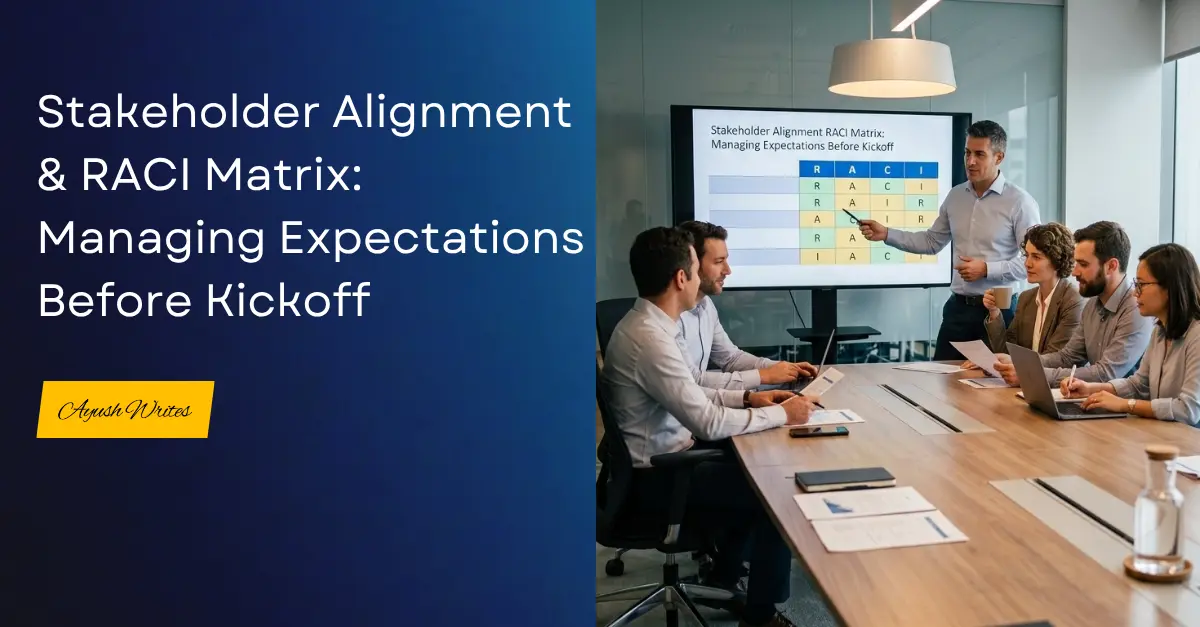


Stakeholder Alignment & RACI Matrix: Managing Expectations Before Kickoff

Stakeholder Alignment & RACI Matrix

In complex enterprise delivery, execution failure rarely stems from technical capability; it stems from structural governance breakdowns. When approval cycles stall, scope drifts, or cross-functional teams duplicate effort, introducing superficial fixes like daily syncs or status dashboards fails to resolve the underlying friction. The root issue is an unaddressed governance deficit: key stakeholders were never formally aligned on decision rights, authority limits, and delivery boundaries before execution.


A Stakeholder Alignment RACI Matrix is an operational governance framework that maps every project milestone, task, and decision to specific roles using four explicit levels of involvement: Responsible, Accountable, Consulted, and Informed. By defining these boundaries before kickoff, it eliminates role ambiguity, accelerates sign-offs, and protects project margins.


The Operational Impact of Role Ambiguity


Project managers frequently operate under the flawed assumption that cross-functional teams and executive sponsors share an implicit understanding of operational ownership. In practice, unwritten expectations create severe delivery bottlenecks that erode financial margins and delay time-to-market.


Research on decision-making efficiency by McKinsey & Company reveals that only 20% of enterprise leaders believe their organization excels at decision-making, with the vast majority citing unclear decision rights and redundant review layers as major drivers of wasted management time.


  • Capacity Loss: Ineffective decision protocols consume over half the time managers spend on project execution.
  • Decision Velocity: Establishing clear accountability makes teams 6.8x more likely to make high-quality decisions quickly.
  • Capital Efficiency: Simplifying governance and decision rights frees up 20% to 60% of management capacity, directly reducing project overhead costs.

Establishing a formal governance structure eliminates baseline ambiguity, optimizes decision velocity, and protects operational margins. A structured RACI matrix provides the framework necessary to align cross-functional leads and maintain delivery momentum.

What is a Stakeholder Alignment RACI Matrix?


Stakeholder alignment is the active process of bringing project sponsors, operational leads, and delivery teams into explicit agreement regarding goals, resource allocations, and quality benchmarks. True alignment goes beyond a passive kickoff presentation; it requires a living governance model that establishes clear operational boundaries.


When unexpected friction arises during execution, a pre-established RACI matrix gives project leads an objective framework to diagnose ownership gaps, gather targeted feedback, and resolve authority disputes in real time without defaulting to internal politics.


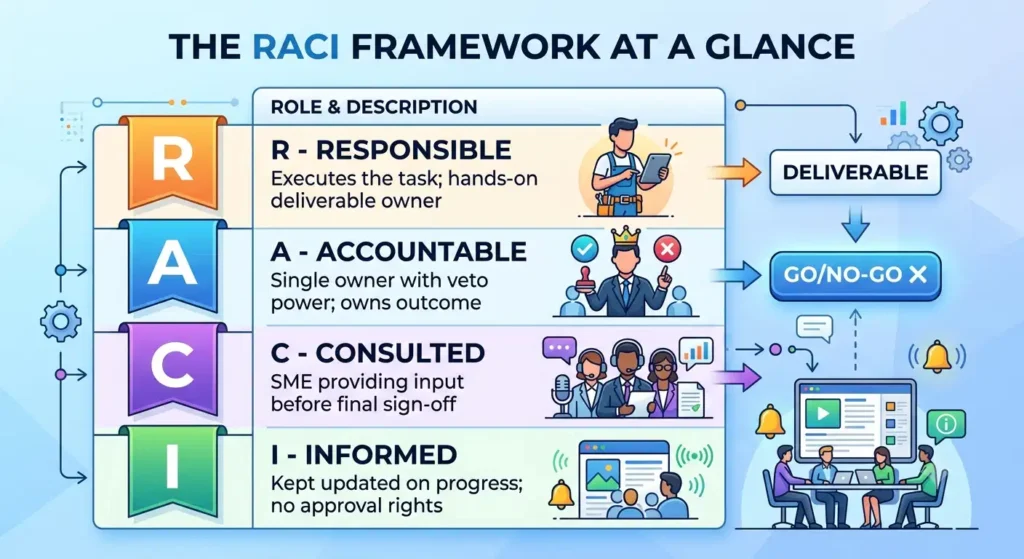
The RACI model categorizes operational involvement across four distinct roles:

  • Responsible (R): The execution lead or team member tasked with actively completing the work required for a deliverable.
  • Accountable (A): The single individual with final decision-making authority and veto power. Exactly one Accountable role must be assigned per deliverable to prevent governance confusion.
  • Consulted (C): Subject matter experts whose functional input, technical requirements, or advisory feedback are required before a decision or deliverable is finalized.
  • Informed (I): Stakeholders who receive status updates on progress and key milestones, but do not possess direct review power or veto rights over execution.

Documenting these explicit role boundaries before kickoff transforms informal assumptions into enforceable operational standards, eliminating decision bottlenecks and ensuring predictable, high-margin delivery from day one.

RACI Model Framework

Decoding the RACI Matrix: Roles and Definitions


While the high-level definitions are straightforward, enforcing operational boundaries during execution requires strict adherence to baseline governance rules.


1. Responsible (R): Operational Execution

  • Execution Boundary: The hands-on lead or team doing the work to create the deliverable.
  • Assignment Rule: Multiple individuals can share an R for complex tasks requiring co-creation (e.g., frontend and backend developers collaborating on an API).

2. Accountable (A): Governance & Veto Authority

  • Execution Boundary: The final decision-maker who owns the quality standard, budget, and business outcome.
  • The Non-Negotiable Rule: Exactly ONE “Accountable” lead per task. Assigning multiple Accountable roles splits ownership, stalls decision velocity, and destroys governance.

3. Consulted (C): Technical & Subject Matter Advisory

  • Execution Boundary: Functional experts whose specialized input is required before work is finalized.
  • Assignment Rule: Consultation must be two-way and time-bound. Advisors provide critical context, but they do not hold veto power unless explicitly designated as the A.

4. Informed (I): Milestone Tracking & Status Visibility

  • Execution Boundary: Stakeholders who require progress visibility but no direct operational involvement.
  • Assignment Rule: Communication is strictly one-way via automated dashboards or periodic updates. They cannot stall execution or demand review cycles.

Step-by-Step Guide: How to Build an Effective RACI Matrix


Building a RACI matrix is an exercise in establishing clear operational boundaries before work begins. Follow this five-step workflow to map roles accurately and prevent governance issues during execution.


Step 1: Analyze and Map Project Deliverables

Start by analyzing the project scope and breaking it down into distinct tasks, milestones, and decision gates. List these vertically on the left-hand column of your matrix.

  • Focus on completion-based deliverables (e.g., “Architecture Design Sign-off” or “QA Test Execution”) rather than generic administrative activities.
  • Keep the list high-level enough to remain manageable; aim for 10 to 25 key milestones per matrix.

Step 2: Identify Roles and Stakeholders

List all cross-functional team members, subject matter experts, and executive sponsors horizontally across the top row.

  • Map by job role or functional title (e.g., Lead Architect, Product Owner, QA Lead) rather than individual names. This ensures the matrix remains valid even if staffing changes.

Step 3: Assign Execution Responsibilities (Responsible)

Go task by task and determine who will perform the actual work required to complete the deliverable.

  • Place an R under the role(s) executing the task.
  • Operational Rule: Multiple roles can share an R if the task requires collaborative effort, but keep the execution team as lean as possible to avoid redundant work.

Step 4: Establish Single-Point Ownership (Accountable)

Assign the single role that holds final approval authority, veto power, and ultimate ownership over the deliverable’s quality standard.

  • Place an A under the single decision-maker for each row.
  • Non-Negotiable Rule: Every task must have exactly ONE “Accountable” role. Never share accountability across multiple roles; splitting an A destroys governance and creates decision bottlenecks.

Step 5: Define Consultation and Information Protocols (Consulted & Informed)

Complete the matrix by setting expectations for subject matter input and progress tracking.

  • Place a C under functional experts whose advisory input is required before work is finalized. Keep this two-way feedback loop time-bound.
  • Place an I under stakeholders who need visibility into progress, milestones, or completion status via one-way reporting. Ensure they understand an I designation carries no veto power over daily execution.


Common Pitfalls in RACI Implementation (and How to Avoid Them)

Even well-intentioned delivery leads run into governance traps when implementing a RACI matrix. Identifying these common operational anti-patterns early ensures your matrix accelerates delivery rather than adding useless administrative overhead.


1. Assigning Multiple “Accountable” Roles to a Single Task

  • The Pitfall: Designating two or more leads as “Accountable” (A) to share ownership or avoid organizational politics.
  • The Impact: Splitting accountability creates ambiguous veto authority, leads to conflicting directions, and paralyzes decision velocity when issues arise.
  • How to Avoid: Enforce a strict rule of exactly one “Accountable” role per row. If multiple leads claim ownership, break the task down into smaller sub-deliverables with distinct single-point owners.

2. Over-designating “Consulted” Roles (Review Paralysis)

  • The Pitfall: Placing a “Consulted” (C) tag on every cross-functional lead to make everyone feel included in the process.
  • The Impact: Endless feedback loops, delayed sign-offs, and bloated approval cycles that consume engineering and design capacity.
  • How to Avoid: Reserve the C designation exclusively for subject matter experts whose technical or legal input is mandatory. Define time-bound feedback windows (e.g., 48 hours to review) after which the “Accountable” lead moves forward.

3. Confusing “Responsible” with “Accountable”

  • The Pitfall: Assuming the person executing the task (R) is automatically the decision-maker (A), or vice versa.
  • The Impact: Execution leads feel micromanaged when an Accountable lead steps in, or high-level leads get bogged down in execution tasks.
  • How to Avoid: Clearly separate task execution from decision authority. The Responsible role owns the work output; the Accountable role owns the sign-off and alignment against business outcomes.

4. Treating “Informed” as an Afterthought

  • The Pitfall: Failing to maintain structured communication channels for “Informed” (I) stakeholders.
  • The Impact: Executive sponsors feel out of the loop and drop unexpected, late-stage vetoes right before a major release.
  • How to Avoid: Set up automated status reporting, async dashboards, or milestone summaries. Ensure “Informed” stakeholders know they receive updates for visibility, but do not hold review or approval power over daily work.

5. Creating a Static “RACI and Forget” Document

  • The Pitfall: Building a RACI matrix during kickoff, storing it in a folder, and never referencing it during project execution.
  • The Impact: Roles revert to informal assumptions as project scope evolves, re-introducing friction and scope creep.
  • How to Avoid: Treat the RACI matrix as a living operational contract. Revisit and adjust role assignments during sprint planning, scope changes, or major milestone transitions.

Transform Your Operations with Structured Stakeholder Alignment


Achieving operational excellence requires moving beyond informal agreements and establishing clear, enforceable governance. Unclear decision rights and split ownership inevitably lead to delayed sign-offs, bloated review cycles, and eroded project margins. By implementing a structured framework before kickoff, you give your team the clarity needed to execute with confidence, maintain velocity, and deliver consistent value.


Aligning cross-functional teams is an ongoing discipline that touches every phase of project operations. Documenting explicit roles transforms potential friction into predictable workflows, ensuring that every contributor understands their exact impact on delivery outcomes.


Ready to Optimize Your Delivery Workflows?

Building scalable operations requires continuous improvement across process design, capacity planning, and team governance. Explore more operational strategy guides and deep dives on ayushwrites.in.


Frequently Asked Questions

What is the difference between RACI and DACI in project management?

While both frameworks establish governance, the Stakeholder Alignment RACI Matrix focuses on broad operational execution by defining Responsible, Accountable, Consulted, and Informed roles. In contrast, DACI (Driver, Approver, Contributor, Informed) isolates decision-making speed for specific milestones. Incorporating a RACI framework within your broader lean operations architecture ensures long-term alignment across complex, cross-functional project environments.

When should a delivery team implement a RACI matrix?

Implement a RACI matrix during project initiation, prior to formal kickoff and resource allocation. Trigger points include launching cross-functional initiatives, onboarding external vendors, or navigating organizational restructuring where role boundaries are ambiguous. Setting clear governance before execution prevents mid-project friction, keeps approvals moving efficiently, and aligns directly with established agile delivery frameworks to maintain overall team velocity.

What are the main implementation risks of a RACI matrix?

The primary risks stem from over-engineering the matrix or treating it as a static document. Assigning multiple Accountable leads splits authority and paralyzes decision-making, while designating too many Consulted roles creates severe review loops. Furthermore, failing to revisit the matrix when project scope evolves causes teams to default back to unwritten assumptions, completely neutralizing the benefits of formal governance.

How quickly can organizations see ROI from RACI alignment?

Organizations typically observe immediate improvements in decision velocity and sign-off turnaround within the first two sprint cycles. By eliminating redundant review layers and clarifying ownership early, teams drastically reduce time wasted in status meetings. Over the full project lifecycle, this operational alignment prevents late-stage scope creep, protects financial margins, and delivers predictable, high-quality deliverables on schedule.

Thank you for landing on this page and reading my blog. I will be writing more on project management and also cover my life insights as well. Stay tuned and subscribe to my newsletter. 

About Ayush Kumar

Ayush Kumar is an operational strategist and founder of ayushwrites.in, a platform built for enterprise leaders looking to transform chaotic workflows into high-margin growth engines. Specializing in Project Operations and advanced tech stacks, Ayush cuts through corporate fluff to bridge the gap between high-level strategy and scalable execution.


Through The Foundry, he deconstructs real-world business stories and case studies, revealing the exact frameworks behind successful enterprise scaling.


Originally from the “Land of the Ganga,” Ayush infuses his business strategies with human-centric life insights gathered from global travel. Want to scale your operations without the chaos?


Connect with Ayush on LinkedIn: In/AayushKnack

Amazing Years

I started my journey back in 2016, but started working officially since 2023. I worked with so many amazing companies and learnt a lot throughout this journey. And I’m still learning new skills and knowledge. 

Thank you for encouraging Me!

Each time you visit this page, you encourage me to perform better and better. So thank you for visiting and getting to know about me!

Project Governance

Project Governance: Establishing Authority and Accountability

Project Governance: Establishing Authority and Accountability There is a distinct point in every complex project where things can easily fall apart.   It usually doesn’t happen because the engineers don’t know how to build, or because the marketing team lacks...

Read More
Project Portfolio Management Featured

How to Use Project Portfolio Management for Scaling ROI

How to Use Project Portfolio Management for Scaling ROI When managing complex operations, the most dangerous trap isn’t failing to hit a deadline it is letting your team sprint fast in the wrong direction. Delivering a project on time means...

Read More
SLA and OLA Delivery Timelines

How to Enforce SLA and OLA Delivery Timelines

How to Enforce SLA and OLA Delivery Timelines When managing complex operations, the most dangerous trap isn’t failing to hit a deadline it is letting your team sprint fast in the wrong direction. Delivering a technical asset on time means...

Read More