



Why Data Hygiene And Judicial Usage Are Key To Reliable AI

Judicial AI

While I usually write about project management, this time I have to be different and write about judicial AI.


For a long time, my core focus has been handling responsible AI project models. And there is no doubt that every organization is focused on developing a responsible AI model. 


We ensured every data point we put into play was responsible, sticking to strict laws and principles to guide how we train and develop the AI model from the ground up. But the real problem now is: recursive contamination. 


The Real Problem: How We Use It and Recursive Contamination


The real problem lies here: how we use it.


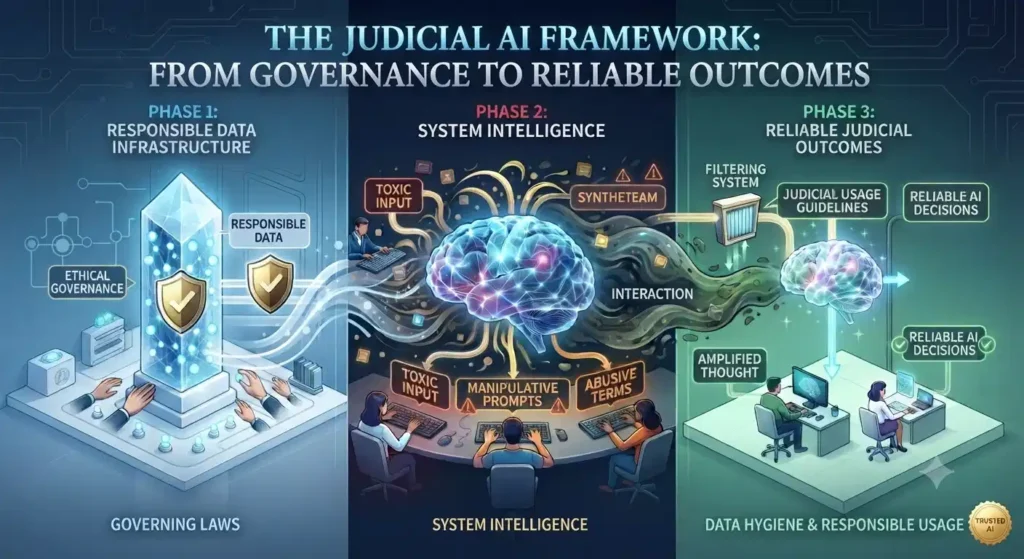
AI was always meant to bring efficiency to the process, but we often drain its potential by relying on it blindly or bypassing deep critical thinking. When models are interacting with messy inputs or recursive data loops, performance begins to degrade. This phenomenon is scientifically documented as model collapse or recursive contamination—where successive generations of models trained on unvetted or synthetic web data gradually lose diversity, factual accuracy, and reasoning capacity.


  • Toxic and Abusive Inputs: Feeding systems manipulative terms or adversarial prompts forces models into defensive collapse or erratic behavior.
  •  
  • The Synthetic Slop Loop: When low-quality web content, unedited AI generations, and shallow text flood the internet, web scrapers ingest it back into future training pipelines. According to foundational research published in Nature on recursive model training, this loop causes systems to forget true data distributions over time.
  •  
  • Data Poisoning Vulnerabilities: Studies highlighted by frameworks like OWASP LLM Top 10 Data and Model Poisoning Risks show that unverified web data and poor interaction loops directly compromise model integrity and increase factual drift.
Judicial AI Filtering System

Why AI Outputs Bad Notes


When an AI model responds on a negative note, it is rarely due to a clean foundational dataset alone. It is a reflection of environmental pollution and interaction friction.

  • Recursive Contamination Effects: As documented in recursive model training studies, when language models ingest unvetted or synthetic web data, successive generations gradually lose factual accuracy and reasoning capacity.
  • The Weight of Environmental Noise: Shifting websites that mass-produce low-grade, manipulative, or unverified content are major contributors to this failure. When models consume this ecosystem, they normalize the noise.
  • Data Poisoning Risks: Frameworks highlighted by OWASP LLM risk assessments show that unverified web data and poor interaction loops directly compromise model integrity and increase factual drift, which is neither a responsible nor a judicial use of AI.


Guidelines for the Judicial and Responsible Use of AI


Instead of pointing fingers at everyday users, the path forward relies on establishing clear behavioral and operational guidelines for judicial interaction:

  • Practice Intentional Prompt Hygiene: Treat your prompts as structural inputs rather than a trash can for toxic, lazy, or abusive text. Clear, high-intent phrasing yields stable, reliable reasoning.
  • Maintain Human-in-the-Loop Verification: Never take AI outputs at face value for critical tasks. Cross-verify generated content against verified primary sources to prevent the spread of unvetted synthetic noise.
  • Enforce Strict Content Provenance: For creators and publishers, ensure that material pushed to the public web adds distinct human value and insight rather than adding to the mass of unoriginal, automated digital clutter.
  • Use AI as an Amplifier, Not a Replacement: Preserve original critical thinking and problem-solving. Use AI to optimize execution and workflow efficiency, keeping human intellect at the center of innovation.

The Path to High-Integrity Interaction


AI was built to assist us, but it can ultimately only reflect what it interacts with. Achieving true judicial AI requires looking beyond the code and the initial training parameters to examine the broader digital ecosystem we maintain.

If we want reliable, high-performing systems that genuinely serve our needs, we have to transition from passive consumption to disciplined, high-integrity interaction across every level of digital deployment.

Frequently Asked Questions

What is Judicial AI, and why is foundational training data alone not enough to guarantee reliable results?

Judicial AI refers to the responsible, accountable, and high-integrity deployment of artificial intelligence systems. While foundational training data is crucial, it is not enough because model performance is heavily influenced by environmental pollution, interaction friction, and recursive contamination from unvetted web data.

How do poor user interactions and toxic inputs impact Judicial AI performance?

When systems are subjected to lazy prompts, manipulative text, or abusive inputs, it creates interaction friction. Without strict Judicial AI practices, these inputs cause models to normalize noise, leading to factual drift and degraded reasoning over successive generations.

What is recursive model training, and how does it affect Judicial AI systems?

Recursive model training occurs when AI models ingest unvetted or synthetic web data generated by low-quality digital ecosystems. Research shows that this feedback loop degrades the reasoning capacity of future Judicial AI models, making data hygiene and content provenance essential.

What are the core guidelines for practicing Judicial AI in daily operations?

Achieving true Judicial AI requires intentional prompt hygiene, maintaining a human-in-the-loop for critical verification, enforcing strict content provenance for publishers, and using AI strictly as an efficiency amplifier rather than a replacement for human critical thinking.

Thank you for landing on this page and reading my blog. I will be writing more on project management and also cover my life insights as well. Stay tuned and subscribe to my newsletter. 

About Ayush Kumar

Ayush Kumar is an operational strategist and founder of ayushwrites.in, a platform built for enterprise leaders looking to transform chaotic workflows into high-margin growth engines. Specializing in Project Operations and advanced tech stacks, Ayush cuts through corporate fluff to bridge the gap between high-level strategy and scalable execution.


Through The Foundry, he deconstructs real-world business stories and case studies, revealing the exact frameworks behind successful enterprise scaling.


Originally from the “Land of the Ganga,” Ayush infuses his business strategies with human-centric life insights gathered from global travel. Want to scale your operations without the chaos?


Connect with Ayush on LinkedIn: In/AayushKnack

Amazing Years

I started my journey back in 2016, but started working officially since 2023. I worked with so many amazing companies and learnt a lot throughout this journey. And I’m still learning new skills and knowledge. 

Thank you for encouraging Me!

Each time you visit this page, you encourage me to perform better and better. So thank you for visiting and getting to know about me!

Project Governance

Project Governance: Establishing Authority and Accountability

Project Governance: Establishing Authority and Accountability There is a distinct point in every complex project where things can easily fall apart.   It usually doesn’t happen because the engineers don’t know how to build, or because the marketing team lacks...

Read More
Project Portfolio Management Featured

How to Use Project Portfolio Management for Scaling ROI

How to Use Project Portfolio Management for Scaling ROI When managing complex operations, the most dangerous trap isn’t failing to hit a deadline it is letting your team sprint fast in the wrong direction. Delivering a project on time means...

Read More
SLA and OLA Delivery Timelines

How to Enforce SLA and OLA Delivery Timelines

How to Enforce SLA and OLA Delivery Timelines When managing complex operations, the most dangerous trap isn’t failing to hit a deadline it is letting your team sprint fast in the wrong direction. Delivering a technical asset on time means...

Read More