

Project Execution Frameworks: Agile, Waterfall, and Hybrid Delivery

Project Execution Framework

Ever feel like your project is sliding off the rails, even though you keep adding extra sync calls and checklists?


When deadlines slip, quick fixes usually fail because the real problem isn’t team performance; it’s that the way you run the project doesn’t match the work being done.


Project execution frameworks are the step-by-step game plans that guide how a project gets built from start to finish. They set the rules for planning tasks, handling changes, and delivering results, whether through a flexible model like Agile, a step-by-step plan like Waterfall, or a Hybrid blend.


Using the wrong approach creates massive friction. According to research from the Project Management Institute (PMI), companies using mismatched project execution frameworks face 28% more project failures and waste nearly 12% of their budget on avoidable rework.


Choosing the right model stops wasted effort, keeps teams aligned, protects margins, and ensures predictable delivery. In this post, we will break down what these frameworks are, compare Agile, Waterfall, and Hybrid models, and help you pick the right one for your team.

What is Project Execution Management?


Project execution management is the active phase where the project plan is turned into actual deliverables. While project planning focuses on setting goals, budgets, and timelines, execution management focuses on daily operational flow: coordinating people, managing resources, tracking task progress, and solving blockers as they happen.


It bridges the gap between strategy and reality by handling four core areas:

  • Resource Coordination: Assigning tasks to the right team members without overloading capacity.
  • Workflow Supervision: Ensuring tasks move smoothly through every stage of delivery without getting stuck.
  • Scope Control: Managing change requests so extra work doesn’t quietly blow out budgets or deadlines.
  • Quality & Communication: Keeping output standards high while keeping stakeholders informed on real progress.

Without solid execution management, even a perfect project plan turns into chaotic fire-fighting. The execution framework you choose serves as the operating system that runs this entire process.


Comparing Agile, Waterfall, and Hybrid Frameworks


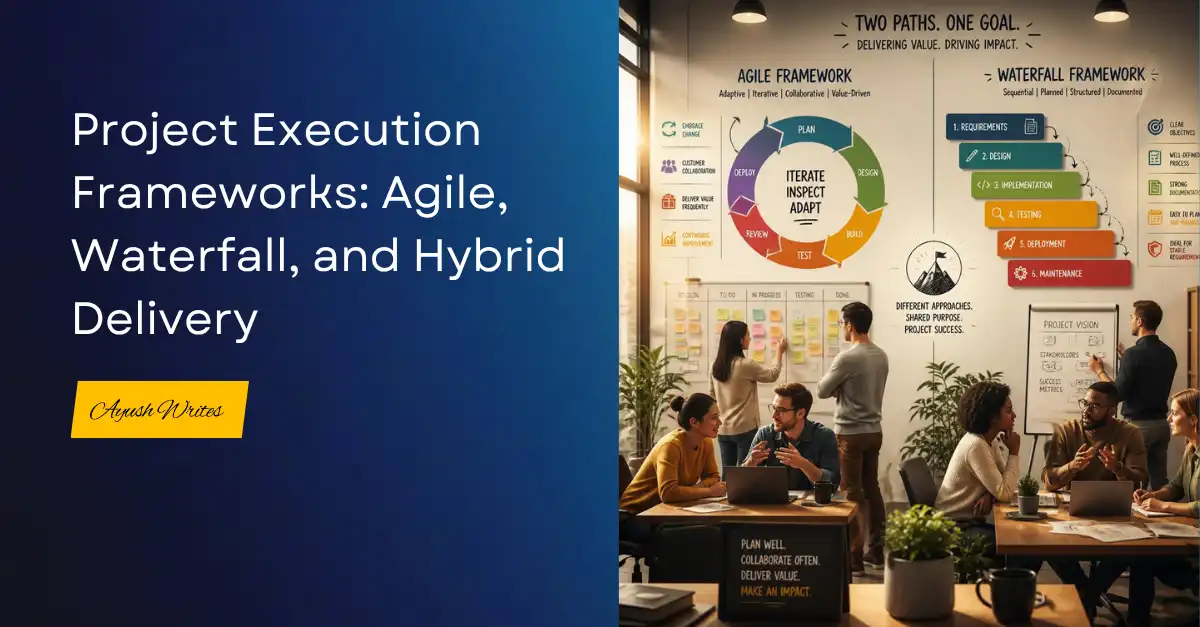
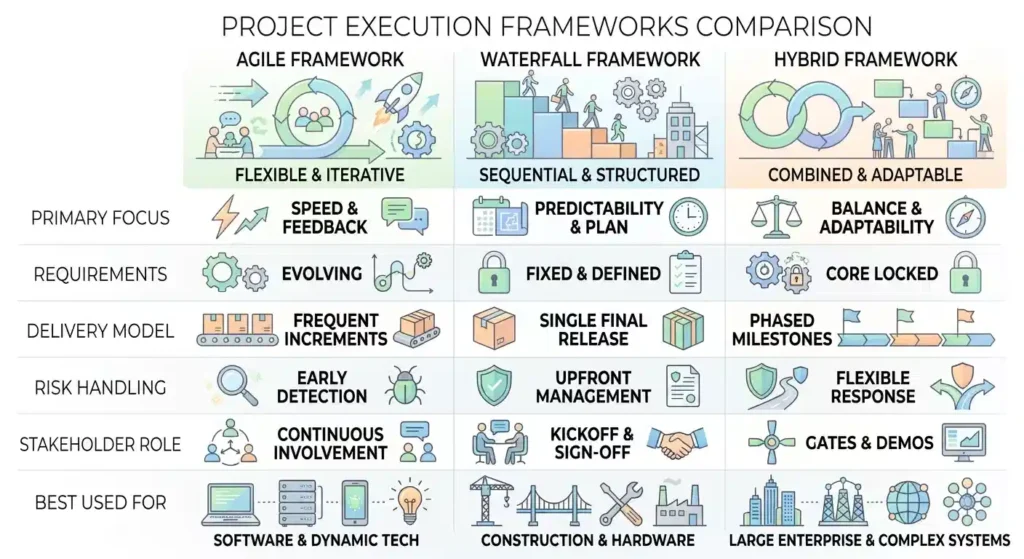
When choosing how to run a project, delivery leads typically rely on three main execution frameworks: Agile, Waterfall, and Hybrid. Each handles changes, planning, and delivery in fundamentally different ways.


  • Agile Framework: A flexible, iterative approach designed for fast-moving environments. Instead of locking down every detail upfront, Agile breaks the project into short cycles (sprints). This allows teams to adapt to changing requirements, get early feedback, and continuously deliver working value while saving time and resources.
  • Waterfall Framework: A sequential, step-by-step methodology where each phase must be completed before the next begins. While often labeled as “outdated,” Waterfall remains essential and practical for projects with fixed budgets, strict compliance rules, or clear, unchanging scopes (such as hardware development or infrastructure builds).
  • Hybrid Framework: A blend of both models that gives project managers the best of both worlds. It uses Waterfall’s structured planning and milestone tracking for executive reporting, combined with Agile’s flexible execution sprints for day-to-day task delivery. It is quickly becoming the go-to setup for modern enterprise PMs.
Project Execution Framework Comparison
Project Execution Framework: Agile, Waterfall and Hybrid

How to Choose the Right Project Execution Framework For Your Projects


Selecting the right execution framework comes down to looking closely at your industry, your deliverables, and the level of uncertainty you expect to face. Rather than forcing a popular framework onto your team, evaluate these key operational factors to make the right choice:


  • Industry Regulations and Compliance: If you operate in healthcare, finance, or government, strict legal standards often demand locked-in requirements and thorough documentation before work begins. In these environments, Waterfall or a heavily governed Hybrid model is usually required.
  • Product Type (Manufacturing vs. Service/Digital): Physical manufacturing and hardware builds involve raw materials, supply chains, and high costs for rework. You cannot easily change a physical mold midway through production, making Waterfall or Hybrid the logical choice. Digital services and software, on the other hand, can be modified continuously using Agile.
  • Scope Stability vs. Uncertainty: Ask yourself how likely the project requirements are to change. If client goals are fixed and fully clear from day one, Waterfall keeps the project predictable. If you are building a novel product where user feedback will shape the final outcome, Agile prevents wasted budget by letting you adapt on the fly.
  • Client and Stakeholder Engagement: Agile requires active, weekly involvement from stakeholders to review iterations and provide feedback. If your client or executive team only wants to see major milestone results at key sign-off gates, a Waterfall or Hybrid structure will better match their expectations.

Key Benefits of Aligning Your Delivery Framework


Matching the correct framework to your project type delivers clear operational advantages:


  • Reduced Financial Waste: Eliminates costly rework by preventing teams from using flexible models on fixed-scope projects (or rigid models on unpredictable ones).
  • Improved Delivery Velocity: Keeps tasks moving smoothly through production without getting stalled in constant approval loops or scope confusion.
  • Clearer Risk Management: Identifies potential blockers early—whether through Agile sprint retrospectives or Waterfall risk registers—before they cause deadline delays.
  • Higher Stakeholder Satisfaction: Sets realistic expectations from day one, ensuring clients receive deliverables that match both their timeline and quality standards.

Transform Your Operations by Choosing the Right Delivery Model


Selecting a project execution framework is not a decorative management exercise, it is a fundamental operational strategy. Standardizing on a single delivery model without evaluating scope stability, regulatory requirements, or client dynamics guarantees friction, unnecessary rework, and wasted budget.


While modern product teams default to Agile for its rapid iteration cycles, structured Waterfall processes remain indispensable for compliance-heavy environments, and Hybrid architectures provide the governance necessary for enterprise-scale transformations.


As a project manager or delivery lead, your core responsibility is to match your execution model to the physical realities of the work. By establishing explicit rules for scope changes, resource coordination, and stakeholder visibility before kick-off, you convert chaotic delivery pipelines into predictable, high-margin operations.


Ready to Optimize Your Project Operations?


Building scalable delivery workflows requires continuous refinement across documentation, capacity planning, and operational governance. Explore more deep dives into enterprise project management, process engineering, and workflow optimization on ayushwrites.in.


Frequently Asked Questions

What is a project execution framework?

A project execution framework is a structured operational roadmap that defines how project tasks are planned, managed, and delivered from kickoff to final closure.

Is Waterfall still relevant in modern project management?

Yes. Waterfall remains the preferred framework for projects with fixed budgets, strict regulatory requirements, or physical deliverables such as hardware manufacturing and construction, where scope changes midway are too expensive.

What is the main difference between Agile and Hybrid frameworks?

Agile relies entirely on short, iterative cycles with evolving requirements, whereas Hybrid combines Waterfall’s high-level planning and milestone tracking with Agile’s flexible day-to-day sprint execution.

How do I know if my project needs a Hybrid approach?

A Hybrid approach is ideal when executive stakeholders require fixed timelines and milestone reporting, but the underlying execution teams need flexibility to adapt to changing technical tasks during delivery.

Thank you for landing on this page and reading my blog. I will be writing more on project management and also cover my life insights as well. Stay tuned and subscribe to my newsletter. 

About Ayush Kumar

Ayush Kumar is an operational strategist and founder of ayushwrites.in, a platform built for enterprise leaders looking to transform chaotic workflows into high-margin growth engines. Specializing in Project Operations and advanced tech stacks, Ayush cuts through corporate fluff to bridge the gap between high-level strategy and scalable execution.


Through The Foundry, he deconstructs real-world business stories and case studies, revealing the exact frameworks behind successful enterprise scaling.


Originally from the “Land of the Ganga,” Ayush infuses his business strategies with human-centric life insights gathered from global travel. Want to scale your operations without the chaos?


Connect with Ayush on LinkedIn: In/AayushKnack
Amazing Years

I started my journey back in 2016, but started working officially since 2023. I worked with so many amazing companies and learnt a lot throughout this journey. And I’m still learning new skills and knowledge. 

Thank you for encouraging Me!

Each time you visit this page, you encourage me to perform better and better. So thank you for visiting and getting to know about me!

Project Governance

Project Governance: Establishing Authority and Accountability

Project Governance: Establishing Authority and Accountability There is a distinct point in every complex project where things can easily fall apart.   It usually doesn’t happen because the engineers don’t know how to build, or because the marketing team lacks...

Read More
Project Portfolio Management Featured

How to Use Project Portfolio Management for Scaling ROI

How to Use Project Portfolio Management for Scaling ROI When managing complex operations, the most dangerous trap isn’t failing to hit a deadline it is letting your team sprint fast in the wrong direction. Delivering a project on time means...

Read More
SLA and OLA Delivery Timelines

How to Enforce SLA and OLA Delivery Timelines

How to Enforce SLA and OLA Delivery Timelines When managing complex operations, the most dangerous trap isn’t failing to hit a deadline it is letting your team sprint fast in the wrong direction. Delivering a technical asset on time means...

Read More