

Business Process Re-engineering (BPR): How to Fix Broken Workflows

Business Process Re-engineering

Ever feel like your team is constantly putting out fires caused by a workflow that was broken from day one?


When a process is fundamentally flawed, tweaking a few minor steps or adding another checklist won’t save it. You need a complete reset and that is exactly what Business Process Re-engineering (BPR) is designed to do.


The power of BPR isn’t just theory. In his landmark research published in Reengineering Work: Don’t Automate, Obliterate, operational pioneer Michael Hammer highlighted how Ford overhauled its accounts payable workflow. Instead of simply digitizing paper invoices, Ford eliminated vendor invoices entirely and slashed manual document-matching points from 14 down to just 3. This complete process redesign allowed Ford to surge departmental productivity by 300%, boost payment accuracy past 95%, and reduce administrative headcount by 75%.


BPR gives project managers a framework to stop slapping band-aids on broken systems, strip out hidden friction, and rebuild processes for maximum speed and lower costs.


In this post, we’ll break down what BPR looks like in practice, how it protects your project margins, and how you can use it to fix broken workflows for good.


Legacy processes generate operational debt. When we audit campaign infrastructures, we find that 60% of project delays stem from redundant review loops rather than technical skill gaps. Fixing the system fixes the speed.

What is Business Process Re-engineering?


Business Process Re-engineering (BPR) is the radical redesign of core business processes to achieve dramatic improvements in performance metrics like cost, speed, quality, and service. Instead of making incremental adjustments to existing steps, BPR wipes the slate clean to rebuild workflows from scratch using modern technology and streamlined team structures.

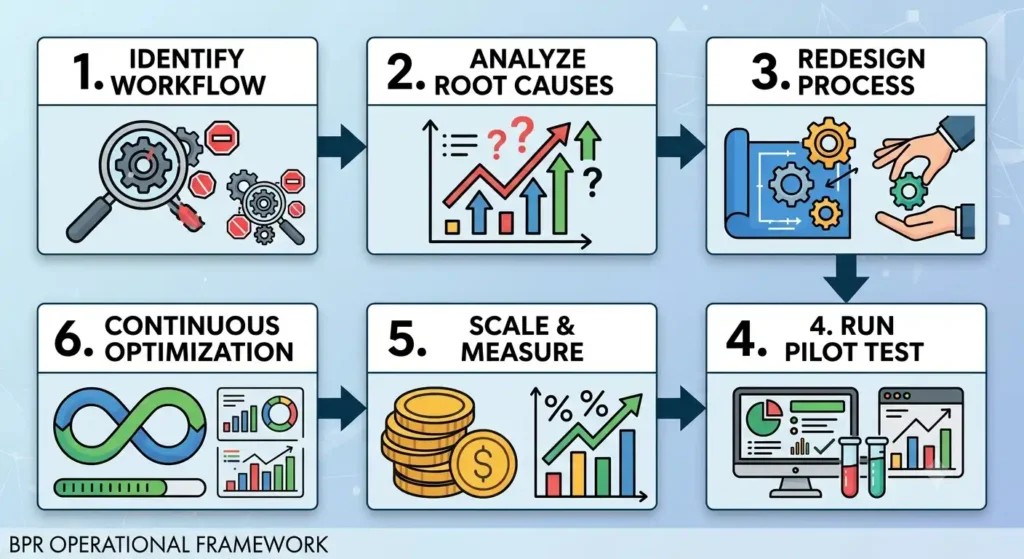
Business Process Re-engineering Steps

Continuous improvement focuses on small, 5% tweaks. Business Process Re-engineering targets 50% operational leaps. We don’t ask how to make a broken process run slightly faster; we ask why we are running that process at all.


While enterprise teams often use business process re-engineering for internal supply chains, delivery leads use it to protect client margins. Rebuilding broken project workflows delivers three immediate advantages:


  • Eliminates Handoff Friction: We cut out middle-layer approvals, manual data re-entry, and scattered Slack threads that stall campaign momentum.
  • Protects Project Margins: Lowering the operational labor required per deliverable expands profitability without forcing teams to work overtime.
  • Drives Measurable Revenue Growth: Consistent, early deliveries turn standard client accounts into long-term retainer growth.

What Are the Steps to Perform Business Process Re-engineering?


Flawless execution requires a clean break from legacy habits. We cannot re-engineer a workflow if we hold onto broken processes out of comfort.


Follow these five steps to execute a complete operational reset across your delivery teams:


  • Identify and Map Core Workflows: We map every active process across our delivery pipeline. Document how the work actually happens today—including every manual handoff and side conversation—rather than the idealized version in your policy doc.
  • Analyze Bottlenecks and Root Causes: Examine where tasks stall. Fact-check the delays: Are team members waiting on client assets, or are internal review layers causing the backlog?
  • Redesign the Process From Zero: Throw out the old checklist. Rebuild the workflow using modern automation, direct role ownership, and minimal approval gates.
  • Test the Redesign in Controlled Pilots: Roll out the new process on a single high-priority campaign. Gather real-time feedback from engineers and account managers on the ground to fix edge cases.
  • Measure Margin Impact and Scale: Track cycle time reductions and error rates against your baseline. Once proven, deploy the new framework across all account streams.

What Are the Key Benefits of Business Process Re-engineering?


Business process re-engineering directly impacts your bottom line by converting operational efficiency into profit. When we strip out friction, we build a faster, more resilient organization.


Operational Metric

Incremental Tweaks (Lean)

Business Process Re-engineering (BPR)

Performance Goal

5% to 10% minor gains

50% to 300% performance jumps

Starting Point

Existing active workflow

Clean slate / Zero-based redesign

Primary Focus

Eliminating minor waste

Eliminating redundant steps & handoffs

Risk & Return

Low risk, modest return

High impact, high margin return

Tech Integration

Automates existing steps

Reconfigures entire stack around the work

  • Dramatically Reduced Cycle Times: Removing redundant reviews cuts task completion times in half, allowing teams to ship work faster.
  • Protected Profit Margins: Eliminating unnecessary administrative tasks directly reduces human resource costs per project.
  • Superior Output Quality: Standardized, automated workflows remove human oversight errors, delivering consistent work to clients.
  • Scalable Operations: Reengineered workflows let delivery teams handle double the account load without doubling headcount.

Transform Your Operations with a Clean-Slate Reset


Tolerating broken, sluggish workflows erodes team morale and destroys project profitability. While minor tweaks have their place, severe operational bottlenecks demand a complete system reset. By stepping back, questioning legacy assumptions, and rebuilding your delivery model from scratch, you create a lean execution engine built for speed, quality, and margin protection.


Ready to stop putting band-aids on failing systems and build a high-converting operating model? Explore our latest articles on ayushwrites.in to discover practical frameworks for optimizing workflows and driving sustainable operational efficiency.


What is the single biggest bottleneck stalling your project workflows right now? Drop your thoughts below to discuss how we can streamline your team’s execution!

Frequently Asked Questions

How does Business Process Re-engineering differ from Lean operations?

Lean operations focuses on continuous, incremental waste reduction within an existing workflow framework. In contrast, Business Process Re-engineering completely abandons the existing framework to build an entirely new workflow from scratch. While Lean refines what you already do, business process re-engineering  changes how you deliver value to achieve massive performance leaps. To see how continuous refinement works alongside radical resets, explore our guide on Lean Process Operations.

When should a business choose BPR over minor process tweaks?

Choose BPR when a core workflow is fundamentally broken, severely impacting client timelines, or eroding project margins despite previous optimization attempts. If small adjustments yield negligible efficiency gains or if your current software stack no longer supports team scale, a full re-engineering effort is necessary. It provides the clean reset required to realign operations with revenue targets.

What are the biggest risks when implementing Business Process Re-engineering?

The primary risks center on organizational change resistance, inadequate training, and unclear role ownership during the transition phase. Because BPR replaces familiar routines with entirely new operating models, team members may push back if leadership fails to communicate the value clearly. Mitigate this risk by involving delivery leads early in the redesign phase and deploying changes through controlled pilots.

How long does a typical BPR project take to show measurable ROI?

Initial operational metrics often improve within 60 to 90 days during the pilot testing phase. Full enterprise adoption and maximum margin expansion typically take three to six months depending on system complexity. Tracking baseline cycle times before launch allows you to measure immediate cost reductions as the redesigned workflow stabilizes across live client accounts.

Does BPR require investing in an entirely new software stack?

Not necessarily, because BPR focuses on restructuring how work flows between people and platforms rather than simply buying new software. While modern automation platforms accelerate results, massive efficiency jumps usually come from eliminating redundant approvals, consolidating handoffs, and enforcing strict task ownership. To evaluate how to streamline your operations, read our operational strategy guides on ayushwrites.in.

Thank you for landing on this page and reading my blog. I will be writing more on project management and also cover my life insights as well. Stay tuned and subscribe to my newsletter. 

About Ayush Kumar

Ayush Kumar is an operational strategist and founder of ayushwrites.in, a platform built for enterprise leaders looking to transform chaotic workflows into high-margin growth engines. Specializing in Project Operations and advanced tech stacks, Ayush cuts through corporate fluff to bridge the gap between high-level strategy and scalable execution.


Through The Foundry, he deconstructs real-world business stories and case studies, revealing the exact frameworks behind successful enterprise scaling.


Originally from the “Land of the Ganga,” Ayush infuses his business strategies with human-centric life insights gathered from global travel. Want to scale your operations without the chaos?


Connect with Ayush on LinkedIn: In/AayushKnack
Amazing Years

I started my journey back in 2016, but started working officially since 2023. I worked with so many amazing companies and learnt a lot throughout this journey. And I’m still learning new skills and knowledge. 

Thank you for encouraging Me!

Each time you visit this page, you encourage me to perform better and better. So thank you for visiting and getting to know about me!

Project Governance

Project Governance: Establishing Authority and Accountability

Project Governance: Establishing Authority and Accountability There is a distinct point in every complex project where things can easily fall apart.   It usually doesn’t happen because the engineers don’t know how to build, or because the marketing team lacks...

Read More
Project Portfolio Management Featured

How to Use Project Portfolio Management for Scaling ROI

How to Use Project Portfolio Management for Scaling ROI When managing complex operations, the most dangerous trap isn’t failing to hit a deadline it is letting your team sprint fast in the wrong direction. Delivering a project on time means...

Read More
SLA and OLA Delivery Timelines

How to Enforce SLA and OLA Delivery Timelines

How to Enforce SLA and OLA Delivery Timelines When managing complex operations, the most dangerous trap isn’t failing to hit a deadline it is letting your team sprint fast in the wrong direction. Delivering a technical asset on time means...

Read More