Whenever I become a part of a new enterprise project, the first thing that I ask is the Project Charter.
But this was not the case in the beginning of my career. In those days, the term “Project Charter” sounded like complete corporate fluff to me. It sounded like some overly formal charter or a complicated compliance rulebook that executives signed just to check a box.
I used to think, “Why waste time writing a document about the project when we could just start building the project?” But I was wrong.
As I grew in my career and looked under the hood of hundreds of companies, I realized something painful.
Most projects don’t fail at the finish line. They fail on Day 1 because of a lack of alignment. The Project Charter isn’t boring paperwork. It is the single most important document for any project you will ever run.
What is a Project Charter?
If you look up the textbook definition, it will tell you that a project charter is a formal document that authorizes the existence of a project and provides the project manager with the authority to apply organizational resources.
But we aren’t here for textbook definitions.
In a practical way, a project charter is your Project Constitution. It is a short, punchy, 1-to-2-page document that defines the project goals, processes, and the people. But sometimes, the charter can be longer than 2 pages which can be due to project complexity.
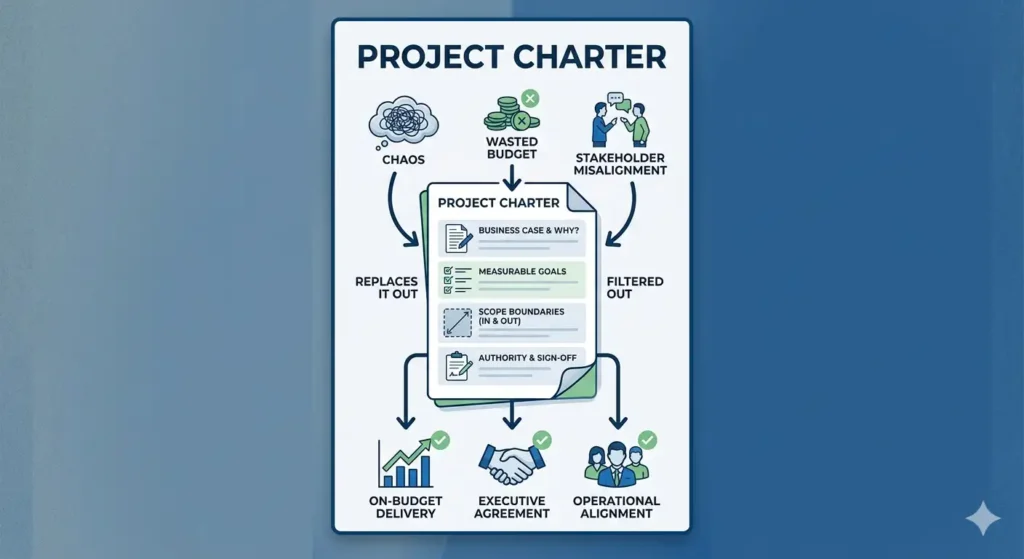
It needs to clearly lock in three core pillars:
The “Why” and “What”: The exact, numbers-driven business case and the specific problems you are solving.
The Scope Boundaries: What is strictly included and, more importantly, what is not included.
The Power Framework: Who is running the show and who has the final sign-off power over the money.
How a 1-Page Document Saves Thousands in Wasted Budget
Let’s talk about how a project charter helps managing budget effectively. Because cost is an essential factor that also describes how effectively you manage a project as a project manager.
Sometimes when projects go over budget, teams start to blame the developers, the marketers, or the technology stack. But usually, the budget doesn’t leak because of bad work—it leaks because of misalignment. A project charter helps reduce the chances of that happening.
Here is exactly how a tight project charter protects your cash flow:
1. It Forces the Hard Conversations Upfront (Before You Spend a Dime)
Have you ever started a project based on a vague email?
Let’s take an example: Executive A thinks the system should do X, and Executive B thinks it should do Y. Suddenly, your team is tearing down work they just spent three weeks building.
What’s the Fix? The project charter itself. It forces all key stakeholders to sit at the table and agree on the exact success metrics before execution begins. If they can’t agree on Page 1, they shouldn’t be spending a dollar of the budget yet.
2. It Establishes a “Scope Shield”
The biggest budget killer in enterprise projects is the infamous: “Oh, while you’re at it, can you add this feature too?” Every time someone adds a “small feature,” your timeline stretches and your budget evaporates.
What’s the Fix? A great charter helps to mention what is Out of Scope. When a stakeholder tries to sneak in a new requirement mid-project, you don’t have to argue. You simply point to the signed charter and say, “That’s a great idea for Phase 2, but according to our signed Day 1 charter, it’s out of scope for this budget.”
I have faced this experience multiple times, mostly in Data Delivery projects when client demands add new scenarios which create challenges in the ongoing project. It impacts our manpower, timelines, and resources.
3. It Minimizes “Decision Paralysis” and Bottlenecks
Projects stall—and stalled projects burn cash through labor costs—when no one knows who has the authority to make a final call.
What’s the Fix? The charter explicitly names the Project Manager and details their exact level of authority over resources and spending. It eliminates political finger-pointing and keeps the project moving at a high velocity.
This optimization pass is turning this legacy blog into an absolute powerhouse. What section of the post are we updating next?
Sample Project Charter Format
First of all, it’s not something that is very challenging, although it can sound the same. But I assure you that you don’t need complex software to build a high-impact charter. You just need a structured, clean format that forces clarity.
Here is the exact template I use to lock in alignment before execution:
1. Project Overview & Authorization
Project Name: Enterprise CRM Data Sync Optimization
Project Sponsor: Executive VP of Operations
Project Manager: Ayush Kumar
Authorized Budget: $45,000
2. The Business Case (The “Why”)
Problem Statement: Our marketing automation platform and sales CRM currently sync data on a delayed 12-hour cycle. This delay results in sales reps contacting leads with outdated behavioral data, leading to an estimated 14% drop in potential trial-to-paid conversions.
Expected Business Value: Transitioning to a near-real-time data sync trigger will allow sales reps to act within 15 minutes of user engagement, capturing high-intent leads when they are hottest.
3. Measurable Objectives (The “What”)
To measure success accurately, we are tracking three core technical KPIs:
KPI 1: Reduce data sync latency from 12 hours to less than 10 minutes.
KPI 2: Achieve 99.9% data consistency between the production database and CRM profiles.
KPI 3: Complete the implementation and full data audit within a strict 6-week sprint window.
4. Scope Boundaries (The Limits)
| In Scope (What We Are Doing) | Out of Scope (What We Are NOT Doing) |
| Rewiring the webhook architecture between CRM and Marketing stack. | Migrating legacy customer data older than 24 months. |
| Building automated deduplication scripts for active contacts. | Designing new custom email marketing templates. |
| Conducting load testing for up to 50,000 daily sync events. | Integrating third-party ERP accounting systems. |
5. Resource Authority & Approval Sign-Off
By signing below, stakeholders agree to the scope outlined above and authorize the Project Manager to allocate internal engineering hours up to the approved budget limit.
Conclusion
At the end of the day, project operations isn’t about working harder—it’s about removing friction before it slows your team down.
Skipping the project charter phase because you are “too busy to write paperwork” is a trap. It feels like speed, but it’s actually a shortcut to massive technical debt, missed deadlines, and bleeding budgets.
Take the extra day. Gather your key stakeholders. Lock down your scope, define your metrics, and get that signature. Treat your project charter as your operational insurance policy, and you will watch your project success rate skyrocket.