

How to Enforce SLA and OLA Delivery Timelines

SLA and OLA Delivery Timelines

When managing complex operations, the most dangerous trap isn’t failing to hit a deadline it is letting your team sprint fast in the wrong direction. Delivering a technical asset on time means absolutely nothing if your internal development teams and external marketing ops assets are not operationally aligned.


Think about a high-end restaurant kitchen. If the chef prepares a steak perfectly in five minutes, but the expo team takes fifteen minutes to plate it, the customer gets a cold meal. The execution was fine, but the hand-off failed.


Your delivery schedules require that exact same discipline. Bandwidth is finite. Without a strict filtering mechanism to prioritize tasks against commercial milestones, you are simply subsidizing chaos and bleeding cash. Reclaiming control over your operational pipeline demands a deliberate approach to internal and external commitments, it is the only way to convert raw hustle into predictable revenue growth.


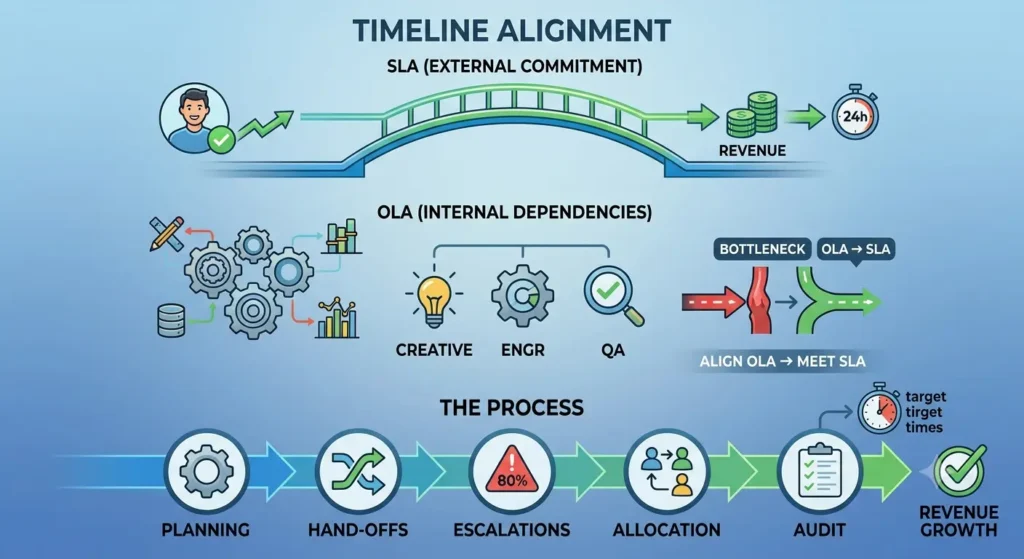
SLA and OLA Delivery Timelines are formalized operational benchmarks used to define and measure service performance. Service Level Agreements (SLAs) govern the delivery commitments made between a service provider and an external customer, while Operational Level Agreements (OLAs) define the internal team dependencies required to meet those overarching consumer deadlines.

What are SLA and OLA Delivery Timelines?


At their core, SLA and OLA Delivery Timelines serve as the structural framework that ensures accountability across your entire ecosystem. We use this system to bridge the gap between technical execution and client expectations.


To enforce these effectively, we must break down the two distinct layers:

  • Service Level Agreements (SLAs): This is your external commitment. It outlines the final turnaround time, quality standard, and baseline requirements your client expects to receive.
  • Operational Level Agreements (OLAs): This is your internal engine. It details the exact obligations between your cross-functional departments—like marketing, engineering, or design—that must occur to fulfill the master external contract.


Ultimately, your operational speed hinges entirely on how tightly these two metrics align. If your client agreement promises a 24-hour turnaround time (SLA), but your internal design hand-off protocol takes 48 hours (OLA), your system is fundamentally broken from day one.


Why does this matter? Because execution without tracking is a direct shortcut to client churn. When we run an operation, we cannot rely on verbal agreements. We must evaluate every hand-off based on its direct contribution to the delivery pipeline.


Before any external contract is signed, we run a strict operational audit on our internal infrastructure. We map out the exact internal processing speeds against customer expectations. If our current OLA bottlenecks threaten to derail the timeline, we optimize internal processes before locking down the external customer commitment.

SLA and OLA Delivery Timelines Blog

How to Effectively Manage SLA and OLA Delivery Timelines


We establish and enforce our SLA and OLA Delivery Timelines through a definitive, five-step execution pipeline built for maximum velocity.


1. Document Internal Capacity Baselines


Before you commit to a client deadline, look at your internal capacity. We calculate the exact number of total operational hours our engineering and operations teams need to complete specific sub-parts of a project. Know your true internal processing speed first.


2. Map Cross-Departmental Hand-offs


Run a deep analysis on how tasks move between teams. We trace the exact moment a ticket leaves the creative team and enters the technical deployment phase. Fact-check: Over 70% of missed milestones occur during inter-departmental hand-offs, not during actual task execution. For example, during a recent HubSpot migration, a simple 2-hour delay between the data engineering team and the QA team pushed our entire deployment window back by an entire day.


3. Establish Automatic Escalation Protocols


Never wait for a customer to complain before realizing a milestone is late.


We program automation triggers within our infrastructure (such as Jira or automation stacks) to send instant warnings when an internal milestone approaches 80% of its allocation limit without a status change.


4. Deploy Predictive Resource Allocation


If a high-priority project approaches its critical delivery threshold, dynamically shift manpower to clear the roadblock. Never let a predictable bottleneck derail a high-margin external milestone.


5. Review Performance Logs


Explicitly audit your historical tracking data every single month. Pinpoint exactly which internal teams are meeting their targets and which dependencies are causing delivery lag.


The Master Timeline Enforcement Blueprint


We use this standardized structured data layout to track and enforce operational accountability across our delivery pipeline.


Agreement Level

Responsible Party

Delivery Milestone Target

Breach Threshold

Penalty / Escalation Path

Status

SLA (External)

Technical Account Director

24-Hour Final Deployment

> 24 Hours

Contract Penalty / Tier 3 Management Escalation

Active

OLA (Internal)

Creative & Design Assets Team

4-Hour Asset Delivery

> 6 Hours

Shift Designer Bandwidth / Tier 1 Slack Warning

Active

OLA (Internal)

Data Operations & QA Team

2-Hour Validation Sprint

> 3 Hours

Automated Jira Ticket Escalation to Operations Lead

Active

Treating internal timelines as flexible suggestions while expecting flawless client delivery is a direct path to operational failure. Unmapped hand-offs will completely destroy your margins and alienate your best accounts.


True operational velocity requires clear boundaries. Lock down your cross-departmental commitments, hold your internal teams to explicit data thresholds, and build absolute transparency into your daily execution. Treat these agreements as the literal flight plan for your business get them right before takeoff, and your team will hit every single milestone with automated precision.

Frequently Asked Questions

What is the main difference between an SLA and an OLA?

A Service Level Agreement (SLA) focuses entirely on the external relationship, setting the delivery expectations between the service provider and the customer. An Operational Level Agreement (OLA) focuses entirely on internal relationships, outlining how various backend teams support each other to meet that master external timeline.

How do you prevent internal teams from ignoring OLA commitments?

We use automated notifications and clear escalation structures linked directly to performance metrics. If an internal dependency breaks a pre-defined threshold, the issue immediately surfaces to department leads to ensure resources are re-allocated before the external customer contract is breached.

Can an organization fulfill its SLAs without establishing OLAs?

No. Attempting to meet customer deadlines without internal guardrails relies entirely on individual heroism. Without documented internal hand-off guidelines, teams operate in silos, creating massive operational lag that inevitably causes missed customer targets.

How often should we audit our SLA and OLA targets?

 We audit our delivery data every month to identify systemic operational bottlenecks. Regular reviews ensure our timelines match real-world team velocity, allowing us to adjust capacity or optimize internal software stacks as the business scales.

Thank you for landing on this page and reading my blog. I will be writing more on project management and also cover my life insights as well. Stay tuned and subscribe to my newsletter. 

About Ayush Kumar

Ayush Kumar is an operational strategist and founder of ayushwrites.in, a platform built for enterprise leaders looking to transform chaotic workflows into high-margin growth engines. Specializing in Project Operations and advanced tech stacks, Ayush cuts through corporate fluff to bridge the gap between high-level strategy and scalable execution.


Through The Foundry, he deconstructs real-world business stories and case studies, revealing the exact frameworks behind successful enterprise scaling.


Originally from the “Land of the Ganga,” Ayush infuses his business strategies with human-centric life insights gathered from global travel. Want to scale your operations without the chaos?


Connect with Ayush on LinkedIn: In/AayushKnack
Amazing Years

I started my journey back in 2016, but started working officially since 2023. I worked with so many amazing companies and learnt a lot throughout this journey. And I’m still learning new skills and knowledge. 

Thank you for encouraging Me!

Each time you visit this page, you encourage me to perform better and better. So thank you for visiting and getting to know about me!

Project Governance

Project Governance: Establishing Authority and Accountability

Project Governance: Establishing Authority and Accountability There is a distinct point in every complex project where things can easily fall apart.   It usually doesn’t happen because the engineers don’t know how to build, or because the marketing team lacks...

Read More
Project Portfolio Management Featured

How to Use Project Portfolio Management for Scaling ROI

How to Use Project Portfolio Management for Scaling ROI When managing complex operations, the most dangerous trap isn’t failing to hit a deadline it is letting your team sprint fast in the wrong direction. Delivering a project on time means...

Read More
SLA and OLA Delivery Timelines

How to Enforce SLA and OLA Delivery Timelines

How to Enforce SLA and OLA Delivery Timelines When managing complex operations, the most dangerous trap isn’t failing to hit a deadline it is letting your team sprint fast in the wrong direction. Delivering a technical asset on time means...

Read More