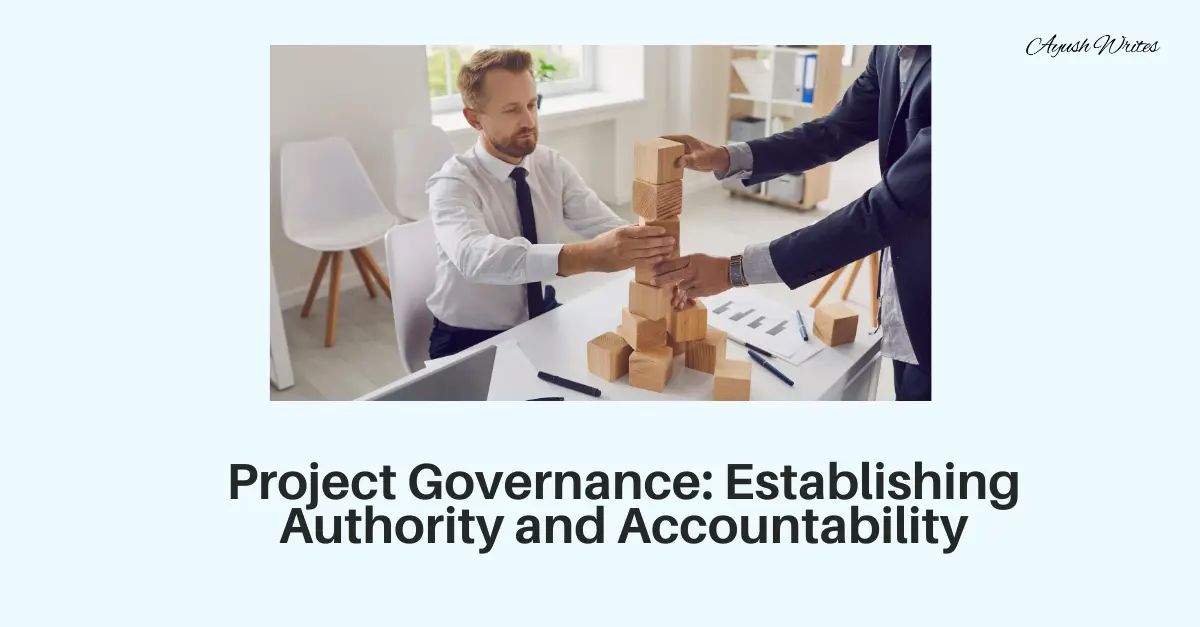


Project Governance: Establishing Authority and Accountability

Project Governance

There is a distinct point in every complex project where things can easily fall apart.


It usually doesn’t happen because the engineers don’t know how to build, or because the marketing team lacks creativity. It happens when an unexpected roadblock hits, and suddenly, nobody knows who actually has the authority to make the final call. The project stalls, the budget bleeds, and the team enters an exhausting loop of endless, indecisive meetings.


Moving from individual execution to managing large-scale operations teaches you one thing very quickly: execution without structure is just chaotic hustle. To scale any operation successfully, you need a framework that defines the rules of the game. That framework is project governance.

What is Project Governance?


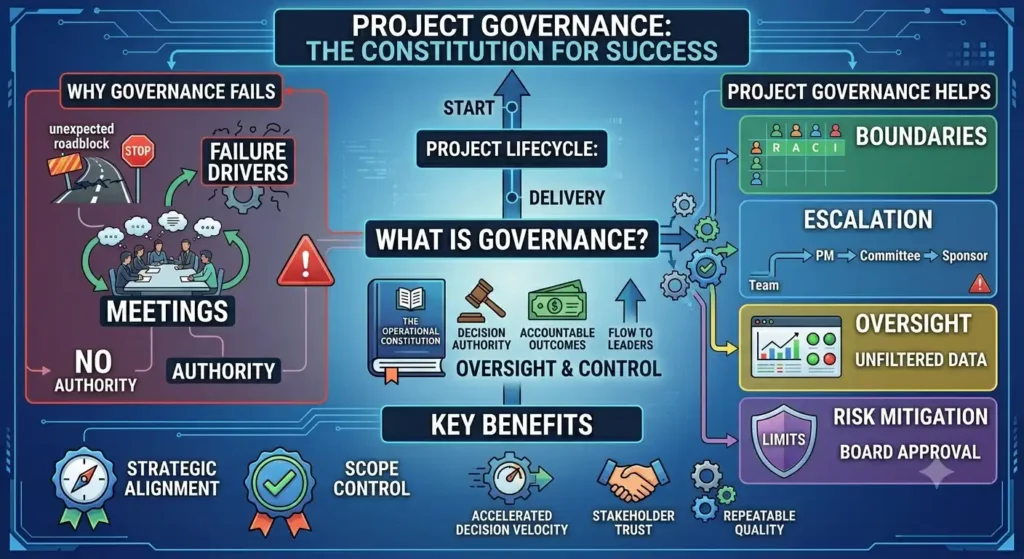
Project governance is the overarching project operations framework within which project decisions are made. I look at it as the operational constitution for your project : the framework that sets the boundaries, rules, and procedures guiding an initiative from its initial kickoff straight through to its final delivery.


It is critical to separate this from day-to-day project management. While project management focuses strictly on the tactical execution of tasks, timelines, and resources, project governance is all about oversight and control. It explicitly maps out:


  • Who holds the ultimate decision-making authority?
  • Who is accountable for specific business outcomes?
  • How information flows between the project team and executive leadership.
Project Governance Success

How Project Governance Helps on the Ground


Project governance acts as the bridge connecting high-level corporate strategy with the ground-level execution of a project. By establishing a clean, organized environment, it helps teams navigate complex lifecycles through a few critical mechanisms:


  • Defining Clear Boundaries: By utilizing structured accountability tools like the RACI matrix (Responsible, Accountable, Consulted, Informed), governance eliminates ambiguity. Everyone knows their specific role, preventing team members from stepping on each other’s toes.
  • Structuring Escalation Pathways: When a project hits a major bottleneck—like a budget overrun or a resource shortage—a project manager often lacks the authority to unilaterally change the baseline. Governance provides a clear, pre-defined pathway for when and how to escalate issues to a steering committee or executive sponsor.
  • Providing Honest Oversight: Through standardized reporting metrics and phase-gate reviews, governance ensures that senior leadership receives accurate, unfiltered data regarding the project’s health, rather than idealized status updates.
  • Mitigating Systemic Risk: It establishes strict threshold limits for variance (e.g., “the project manager can handle up to a 5% budget deviation, but anything higher requires formal board approval”), ensuring risks are managed before they derail the timeline.


Key Benefits and Advantages


When an organization invests in a robust project governance model, the impact on project delivery metrics is immediate and measurable. The primary advantages include:

  • Guaranteed Strategic Alignment: It ensures that organizational resources, time, and capital are never wasted on projects that do no align with the company’s broader long-term goals.
  • Elimination of Scope Creep: By mandating a formal change control process, governance prevents unapproved features or requirements from quietly inflating budgets and pushing out deadlines.
  • Accelerated Decision Velocity: When decision-making rights are explicitly documented, organizations eliminate bureaucratic lag. Problems get solved faster because the exact decision-maker is known.
  • Enhanced Stakeholder Trust: Standardized communication and documented decision histories create deep transparency, keeping clients, executives, and cross-functional teams completely aligned.
  • Repeatable Quality: Because governance introduces standardized processes and quality baselines, project outcomes become predictable and repeatable, rather than relying on luck or individual heroism.

Conclusion


Bypassing project governance because you think it’s just unnecessary corporate friction is a massive mistake. It feels like you’re saving time when you first kick off, but you are actually setting yourself up for an operational nightmare of delayed calls, blown budgets, and total confusion the moment something goes wrong on the ground.


It pays to invest that effort early on to lock down your structural lines. Name your ultimate decision-makers, map out exactly how issues move up the chain, and ensure every team member owns their specific baseline. Look at governance as the ultimate safety net for your operations: get it right at the start, and you will watch your team move faster and hit their targets with absolute precision.


Frequently Asked Questions

How does project governance differ from day-to-day project management?

Project management is purely tactical, focusing on executing daily tasks, tracking timelines, and managing resources. Project governance provides the strategic framework and oversight. It sets the operational rules, defines decision-making authority, and ensures the entire initiative stays aligned with broader business goals.

When should a project manager escalate an issue to the governance board?

Escalation happens when a roadblock breaks pre-defined threshold limits, such as a 5% budget overrun or a critical timeline delay. If a problem requires shifting the project baseline or altering the original scope, it must go to the steering committee.

Does implementing a governance framework slow down project execution?

No, it actually accelerates your velocity. By explicitly documenting decision-making rights and accountability metrics from day one, you eliminate the friction of endless, indecisive meetings. The team knows exactly who grants approvals, completely removing bureaucratic lag.

What is the role of a project sponsor within project governance?

The project sponsor is the ultimate executive owner of the project’s business case. Within the governance framework, they secure funding, provide high-level strategic direction, advocate for the project at the executive level, and hold final sign-off authority for major scope changes.

Thank you for landing on this page and reading my blog. I will be writing more on project management and also cover my life insights as well. Stay tuned and subscribe to my newsletter. 

About Ayush Kumar

Ayush Kumar is an operational strategist and founder of ayushwrites.in, a platform built for enterprise leaders looking to transform chaotic workflows into high-margin growth engines. Specializing in Project Operations and advanced tech stacks, Ayush cuts through corporate fluff to bridge the gap between high-level strategy and scalable execution.


Through The Foundry, he deconstructs real-world business stories and case studies, revealing the exact frameworks behind successful enterprise scaling.


Originally from the “Land of the Ganga,” Ayush infuses his business strategies with human-centric life insights gathered from global travel. Want to scale your operations without the chaos?


Connect with Ayush on LinkedIn: In/AayushKnack
Amazing Years

I started my journey back in 2016, but started working officially since 2023. I worked with so many amazing companies and learnt a lot throughout this journey. And I’m still learning new skills and knowledge. 

Thank you for encouraging Me!

Each time you visit this page, you encourage me to perform better and better. So thank you for visiting and getting to know about me!

Project Governance

Project Governance: Establishing Authority and Accountability

Project Governance: Establishing Authority and Accountability There is a distinct point in every complex project where things can easily fall apart.   It usually doesn’t happen because the engineers don’t know how to build, or because the marketing team lacks...

Read More
Project Portfolio Management Featured

How to Use Project Portfolio Management for Scaling ROI

How to Use Project Portfolio Management for Scaling ROI When managing complex operations, the most dangerous trap isn’t failing to hit a deadline it is letting your team sprint fast in the wrong direction. Delivering a project on time means...

Read More
SLA and OLA Delivery Timelines

How to Enforce SLA and OLA Delivery Timelines

How to Enforce SLA and OLA Delivery Timelines When managing complex operations, the most dangerous trap isn’t failing to hit a deadline it is letting your team sprint fast in the wrong direction. Delivering a technical asset on time means...

Read More