



Zero-Waste MarTech Stack Audit: Stop Wasting 66% of Your Budget

MarTech Stack Audit Image

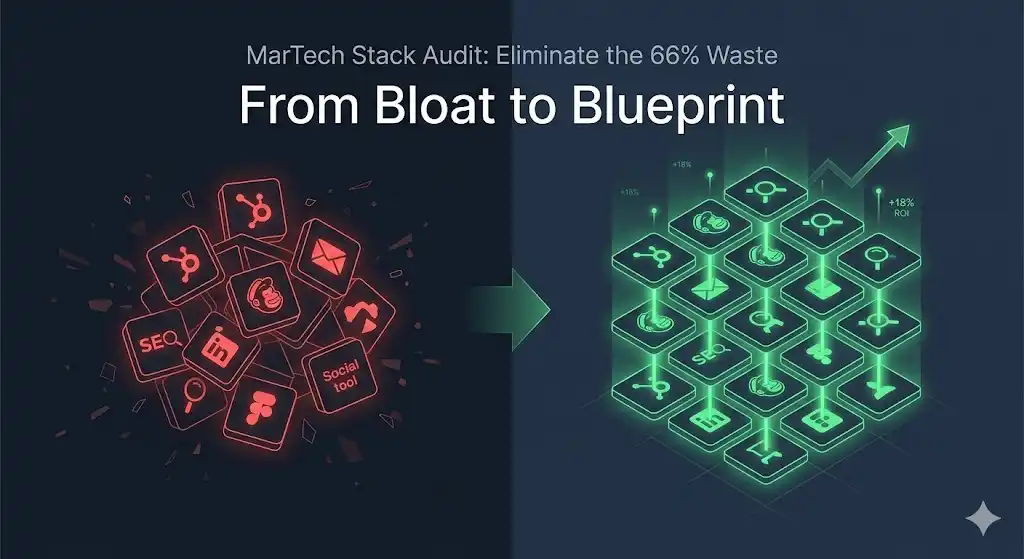
Having a mountain of marketing tools you don’t use is a massive liability. Gartner found that most businesses only use 33% of their tech, meaning you’re flushing the other 66% down the drain. This is why a MarTech stack audit is non-negotiable. You need to find tools that can handle multiple tasks so you can finally cancel the SaaS waste in marketing and unused subscriptions eating your budget.


But before you can start cutting costs, you need to understand exactly what this process looks like and how it works for your business as part of a B2B MarTech roadmap 2026.


What is a MarTech Stack Audit?


A MarTech Stack Audit is a process where we audit the performance and usability of our marketing tools. The goal is to measure their impact to determine whether we actually need them. This is the foundation of marketing technology optimization.


It helps us make clear decisions: should we increase our martech stack capacity, limit it, or stop certain subscriptions altogether? 

By looking at the usability and impact of each tool, you can decide if it’s worth keeping or if it’s just adding to that 66% waste.


MarTech Stack Audit

How do I Conduct a MarTech Stack Audit?


The stack utilization audit process isn’t as difficult as it sounds. All it requires is a common MarTech ROI framework and a clear set of parameters to measure the output. By using a consistent system, you can easily categorize your tools based on whether you need to expand (go premium), maintain (keep the same), or cancel the subscription entirely.


Why these MarTech Stack Audit parameters matter:

Without a fixed system, companies often keep “average” tools or shelfware out of habit. By forcing every tool into one of these three categories, you remove the guesswork and ensure your budget is only tied to high-performing assets.


Here is a three-step MarTech Stack audit process to do the same:


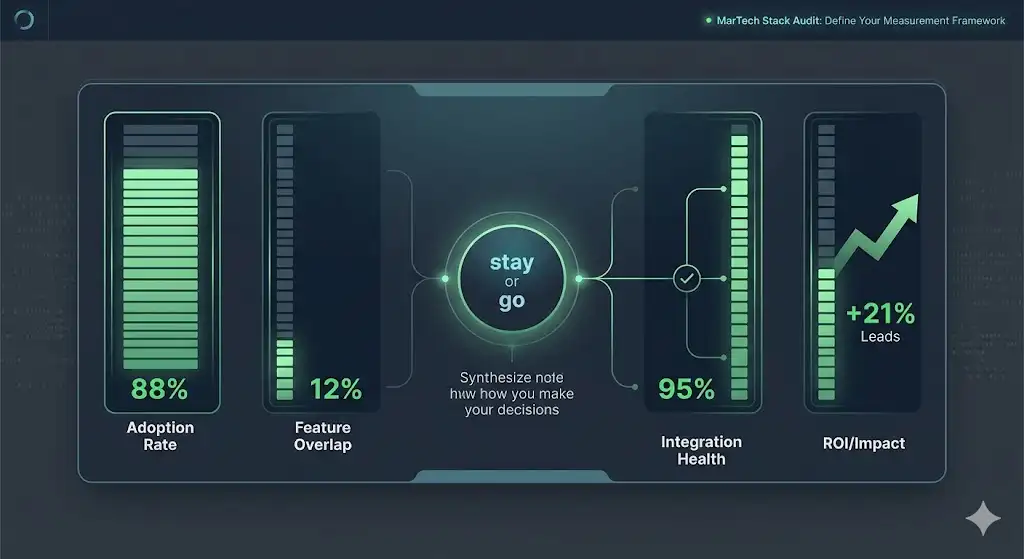
Step 1: Define Your Measurement Framework


To audit effectively, you need a set of indicators to measure every tool against. Use these four key parameters as your “scoring system”:


  • Adoption Rate: What percentage of the team actually uses the tool daily?
  • Feature Overlap: Does another tool in our stack already do this?
  • Integration Health: Does it sync automatically via API connectivity with our CRM/Database?
  • ROI/Impact: Can we point to a specific business result, such as cost-per-lead (CPL) impact, driven by this tool?


Step 2: The Full Inventory & Scoring


List every tool and grade them using the indicators from Step 1. This is where you uncover the 66% waste. You’ll often find tools that score high on contract renewals but very low on team adoption or integration health.


Step 3: Categorize and Execute


Based on your scores, place each tool into a final bucket:

  • Expand: High scores across all indicators; the team needs more capacity to grow.
  • Maintain: Solid scores; the tool is doing its job and earns its keep.
  • Cancel: Low scores in adoption or high scores in feature overlap. These are the tools eating your budget.

Once you’ve categorized your current tools and cleared out the “zombie” subscriptions, you’re left with a clear view of the gaps in your strategy. But a lean stack is only effective if the tools you keep—or eventually add—are built for versatility.

This brings us to the most critical part of the process:

How to Identify the Right MarTech Stack with Maximum Use Cases


Finding the “right” tool isn’t about buying the most famous software; it’s about marketing tool consolidation. You want tools that act as a “one-stop solution” for your marketing operations, allowing you to do more with less.


1. Look for Multi-Department Use Cases


A high-value tool shouldn’t just serve the social media manager; it should provide value across the board. Look for tools that cover these core use cases:


  • Data Centralization:  Does it act as a single source of truth for customer info and first-party data?
  • Workflow Automation: Can it trigger emails, update CRM stages, and alert sales teams simultaneously?
  • Omnichannel Communication: Can it handle email, SMS, and web chat in one interface?
  • Unified Reporting: Does it track the customer journey from the first click to the final sale?


2. Filter by Your Audit Parameters


Before adding or keeping a tool, run it through the “Zero-Waste” filters we discovered:

  • Zero Feature Overlap: If a new tool overlaps with your unified technical stack, it must be better enough to justify the cost.
  • Native Integration: The tool must “talk” to your existing stack. If you have to manually export CSV files to move data, the tool is a bottleneck, not a benefit.
  • Scalability (The “Expand” Factor): Can this tool grow with you? You want a platform where you can start small and expand to premium features as your lead volume increases.


3. Prioritize Ease of Accessibility


A tool can have a million features, but if it lacks proper platform training, it will end up in the waste pile.

  • Lower Learning Curve: Choose tools with intuitive UIs. If your team needs a three-week certification just to send an email, adoption will be low.
  • Mobile & Remote Access: In a modern work environment, your stack must be accessible anywhere. Cloud-native tools with strong mobile apps ensure that data is updated in real-time, not just when someone is at their desk.
  • Self-Service Support: Look for tools with deep documentation and active communities. This ensures that when a problem arises, your team can fix it quickly without waiting 48 hours for a support ticket.

By focusing on these use cases and accessibility markers, you ensure that every budget spent is tied to a tool that the team actually uses. You stop paying for “potential” and start paying for performance.


How to Prevent “Tech Creep” and Maintain a Zero-Waste Stack


Cleaning your stack once is a great start, but the real challenge is keeping it lean. “Tech Creep” happens when small, individual subscriptions are added over time without checking against your core framework. To maintain a zero-waste environment, implement these three habits:


  • The “One In, One Out” Rule: Before adding a new tool to your stack, identify which existing tool it replaces. If it doesn’t replace anything, it must pass a rigorous “ROI vs. Overlap” test before the subscription is approved.
  • Quarterly Micro-Audits: You don’t need a deep dive every month, but a quick quarterly check on Adoption Rates helps you catch “zombie” tools before they drain a full year’s budget.
  • Centralized Procurement: Ensure that all software purchases go through a single person or department. This prevents different teams from accidentally buying three different tools that all do the same thing.

When you stop flushing 66% of your budget down the drain, your MarTech stack stops being a financial liability and starts being a competitive advantage. By auditing for performance and selecting for maximum use cases, you ensure that every dollar you spend is working toward one goal: growing your business.

Conclusion


We’ve covered the “what,” the “why,” and the “how” of integrating a MarTech stack audit into your business strategy. By now, you should have a clear blueprint for transforming a fragmented collection of tools into a unified technical stack that actually protects your budget.


Building a sustainable tech stack is a journey of continuous marketing technology optimization. My experience has proven that the battle against waste is won by those who treat their software as a search intelligence loop: a system focused on maximum utility, not just a list of monthly subscriptions.


I’ll be sharing more deep dives into MarTech Ops, Search Intelligence, and Demand Generation to help you stay ahead of the curve as the digital landscape shifts. Don’t miss the next field report:  subscribe to the newsletter to get these validated strategies and operational frameworks delivered directly to your inbox.


Image Credits: Gemini | For Representation Purpose Only

Frequently Asked Questions

How do I conduct a marketing tech stack audit without losing data?

The key is to map your data flow and audit your API connectivity before hitting the cancel button. You must ensure that your first-party data is fully migrated to your “anchor” tools to maintain a single source of truth. Never terminate a subscription until you’ve verified that all historical touchpoints are successfully synced within your unified technical stack.

What is the industry standard for MarTech tool utilization in 2026?

While many businesses still struggle with the “33%” utilization rate, the 2026 industry standard for high-growth firms is 80% or higher. This is achieved by moving away from specialized “one-off” apps and leaning into marketing tool consolidation. By mastering fewer, more powerful platforms, you eliminate shelfware and ensure your budget is fueling a high-performing demand gen engine.

What are the signs my marketing stack is redundant and costing too much?

 The most obvious sign is the presence of data silos, where information is trapped in tools that don’t talk to each other, forcing manual CSV exports. You should also look for feature overlap, such as paying for three different platforms that all offer “automated workflows.” If your contract renewals are high but your team adoption is low, your stack is officially a financial liability.

Best framework to choose between HubSpot, Salesforce, and specialized MarTech tools?

The best framework is to judge every tool based on integration health and its place in your mOS. Large suites like HubSpot or Salesforce are excellent for reducing SaaS waste in marketing by providing a built-in unified technical stack. However, a specialized tool is worth the investment only if it offers a native connection that significantly improves your search intelligence loop or cost-per-lead (CPL) impact.

What are the essential tools for a modern Marketing Operating System (mOS)?

A modern mOS requires a foundation of tools that prioritize native integration and data flow. You need a robust CRM for first-party data, an automation layer for omnichannel communication, and an intelligence layer for Search Intelligence. The goal is to create a system where every tool supports a centralized B2B MarTech roadmap 2026, rather than operating as an isolated island.

How do I identify "zombie" seats in my SaaS subscriptions?

Utilize a stack utilization audit to track login frequency and feature usage over a 90-day period. Tools with high seat licenses but low active users are primary candidates for downgrading or cancellation. Eliminating these “zombie” costs is the fastest way to improve your MarTech ROI framework without sacrificing functionality.

How does a unified technical stack improve my Search Intelligence?

When your tools are connected, data from your CRM, email, and website feeds into a search intelligence loop that AI engines can crawl. This high-quality first-party data ensures that your brand citations are accurate and consistent across LLMs like Gemini and SearchGPT. A fragmented stack creates conflicting data, which leads to “hallucinations” and lower AI visibility.

What is the impact of MarTech waste on B2B demand generation?

SaaS waste in marketing directly inflates your cost-per-lead (CPL) by diverting budget away from active campaigns. Every dollar spent on shelfware is a dollar not spent on reaching your target audience. A lean, audited stack allows for more aggressive scaling of your demand gen engine by keeping overhead low and efficiency high.

About Ayush Kumar

Ayush Kumar is a strategic content architect dedicated to helping brands transform fragmented marketing efforts into unified growth engines. With a proven track record of developing SEO and content plans for diverse companies, Ayush specializes in leveraging complex tech stacks to drive measurable results.

He is running ayushwrites.in, a platform designed to help businesses navigate the intersection of search intelligence and marketing technology. Originally from the “Land of the Ganga,” Ayush is a traveler at heart, constantly exploring new places and perspectives to fuel his creative strategy.

Connect with Ayush on LinkedIn: In/AayushKnack

Amazing Years

I started my journey back in 2016. I worked with so many amazing companies and learnt a lot throughout this journey. And I’m still learning new skills and knowledge. 

Thank you for encouraging Me!

Each time you visit this page, you encourage me to perform better and better. So thank you for visiting and getting to know about me!

Answer Engine Optimization AEO

Why Your Brand Needs Answer Engine Optimization (AEO) in 2026?

Why Your Brand Needs Answer Engine Optimization (aEO) in 2026 Answer Engine Optimization (AEO) is the next evolution in driving organic website traffic. It enables website owners to gain visibility and authority directly within AI-driven search results. For example, when...

Read More