
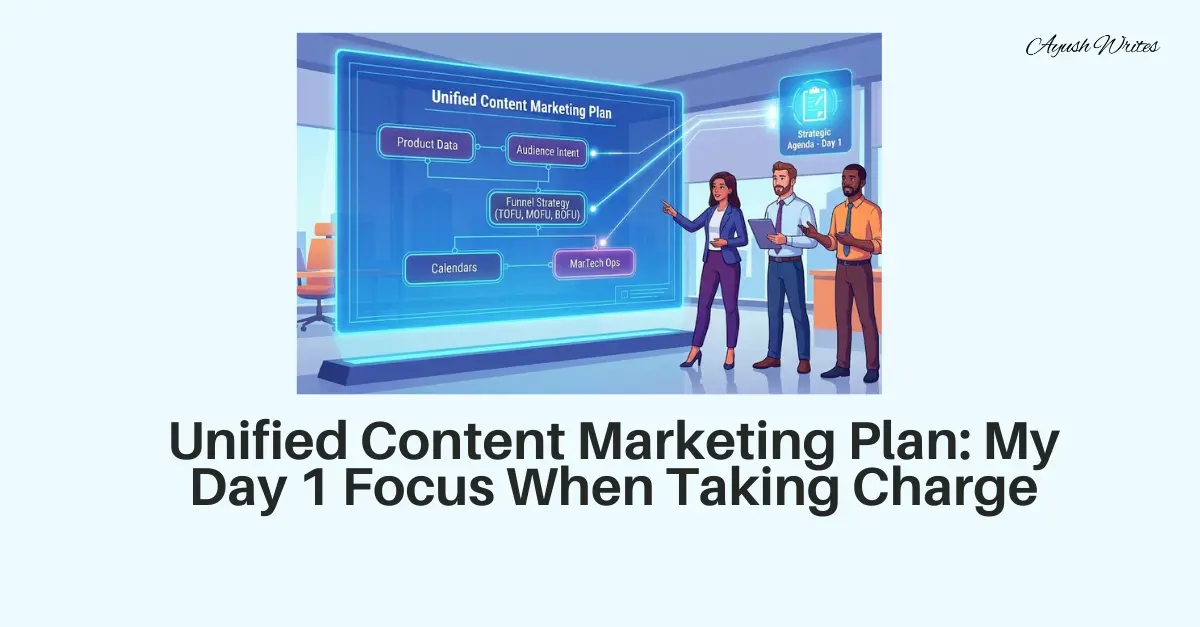

Unified Content Marketing Plan: My Day 1 Focus When Taking Charge

Unified Content Marketing Plan, AyushWrites

A Unified Content Marketing Plan is a strategic blueprint that syncs a brand’s data, tools, and content into one growth engine. By building this within seven days of taking project charge, we establish structural E-E-A-T and ensure all marketing works with Search Intelligence and MarTech Ops.


Speed wins. Every time we take charge of a project, we look for this unified blueprint first. You cannot start the engine without a clear goal and a real plan for how your content must work. Setting the best agenda on Day 1 is a requirement.


Stop wasting your budget on a strategy that doesn’t talk to itself. You deserve a plan where every piece of content actually drives traffic. Let’s dive into why building a Unified Content Marketing Plan is the secret to making that happen.

Why a Unified Content Marketing Plan is Needed?


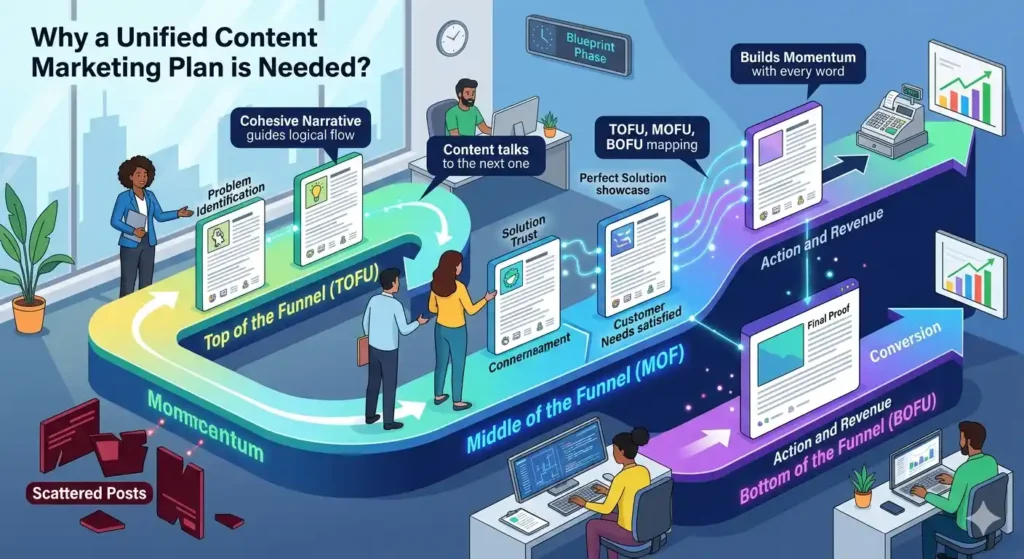
A strategic plan works best when every piece of content actually talks to the next one. It isn’t just about random writing; we craft a series that shows exactly how your product acts as the perfect solution to your customer’s problems.


The secret is continuity. Instead of scattered posts, we build a cohesive narrative that guides your readers through a logical flow. We do this by mapping your writing to each stage of the funnel:

  • Top of the Funnel (TOFU): We create awareness by identifying the core problem and sharing real insights.
  • Middle of the Funnel (MOF): We build deep trust by showing exactly how the product satisfies the customer’s needs.
  • Bottom of the Funnel (BOFU): We provide the final proof that drives action and revenue.

When we align your Unified Content Marketing Plan this way, we turn your blog into a powerful series that builds momentum with every word.


But how do you actually build one from scratch?


In the next section, we are going to see exactly how to build a Unified Content Marketing Plan that turns your strategy into a revenue-driving machine.

How To Build A Unified Content Marketing Plan?


Building a plan that actually moves the needle starts with getting your hands dirty. We don’t just skim the surface; we dive deep into the details of your products and services. We need to know exactly what you do and, more importantly, which specific customer problem you are here to solve.


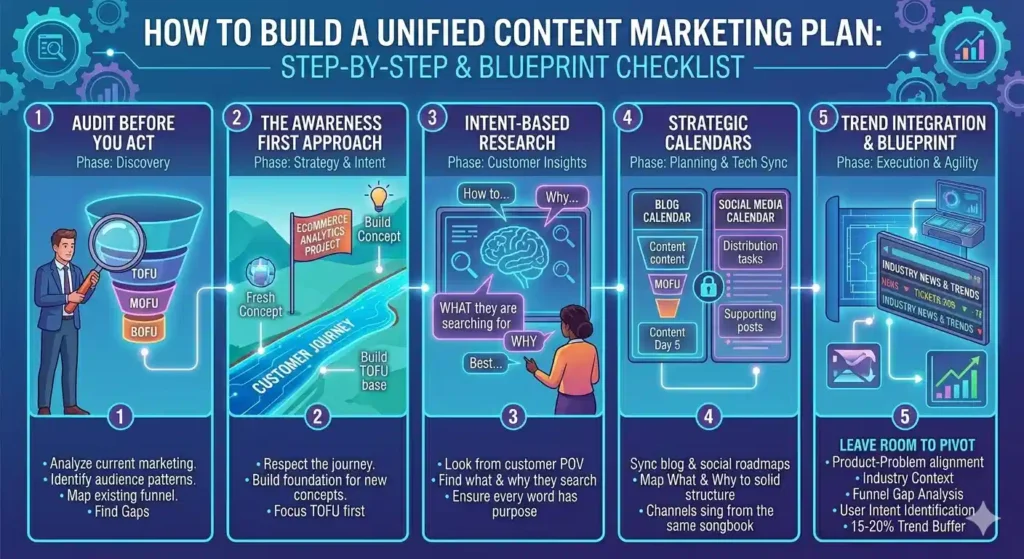
Here is the step-by-step process to get it done:


  • Audit Before You Act: We don’t guess. I start by looking at your current marketing to see what’s already there. Have you already covered the basics at the Top of the Funnel, or are we starting from scratch? Every audience pattern matters, and we need to fill the gaps.
  • The “Awareness First” Approach: Take my work on a new ecommerce analytics project, for example. Since the concept was fresh to the market, I had to build out the TOFU (Top of Funnel) content first just to raise awareness before we could even think about moving people toward a lead or a sale. You have to respect that journey.
  • Intent-Based Research: This is where we switch hats and look at everything from the customer’s point of view. We find out exactly what they are searching for and why. This ensures every word we write has a purpose.
  • Strategic Calendars: Once we know the “what” and “why,” we map it out. I build a dedicated blog calendar and a matching social media calendar so all your channels are singing from the same songbook.
  • Trend Integration: A plan shouldn’t be a cage. We always leave room to pivot for recent industry news and trends so your brand stays relevant in real-time.

By focusing on what the user actually wants and mapping it to a solid structure, your plan stays organized but stays ready to react to the market.


Since we’ve covered the strategy, let’s turn this into an actionable blueprint. This is the checklist I use to ensure every piece of content actually serves a purpose and aligns with the broader MarTech ecosystem.

The Unified Content Marketing Blueprint


This checklist ensures we aren’t just “creating content,” but building a high-authority growth engine that satisfies both your customers and E-E-A-T standards.


Phase 1: The Core Foundation


  • Product-Problem Alignment: Define exactly which specific product feature solves which customer pain point.
  • Industry Context Audit: Map out where your business sits in the current market and identify the primary “needs” you are fulfilling.
  • Funnel Gap Analysis: Audit existing content to see if we have enough coverage for TOFU, MOFU, and BOFU stages.


Phase 2: Intent & Journey Mapping


  • User Intent Identification: Categorize keywords based on what the customer is actually looking for—are they learning (Informational) or ready to buy (Transactional)?
  • The Narrative Series: Group topics into a logical sequence so that a reader at the “Problem” stage (TOFU) is naturally led to the “Solution” stage (BOFU).
  • Technical E-E-A-T Check: Ensure the content reflects real-world experience (like my background in Amazon Quality Ops or Ecommerce Analytics) to build authority.


Phase 3: The MarTech Execution


  • Blog Writing Calendar: Set a consistent 4-week roadmap based on the funnel gaps identified in Phase 1.
  • Social Media Sync: Draft a distribution plan where social posts act as “trailers” for the main blog series.
  • Trend Buffer: Leave 15–20% of your calendar open for reactive content based on industry news and search shifts.
  • Search Intelligence Optimization: Final review to ensure the content is ready for AEO and GEO (AI-driven search engines).


How to Use This Checklist


Start with the Funnel Gap Analysis. If you don’t have enough awareness content (TOFU), your BOFU content will never see the traffic it deserves. By ticking these boxes, we ensure the Unified Content Marketing Plan is structural, intent-driven, and ready to scale.


Conclusion


A Unified Content Marketing Plan is more than just a schedule; it’s a strategic growth engine. By syncing your data, tools, and content within the first week, we move away from scattered writing and toward a cohesive narrative that actually solves customer problems.


Whether we are building awareness at the Top of the Funnel or providing the final proof at the Bottom, every word is backed by Search Intelligence and MarTech Ops. The goal is simple: stop wasting your budget on a strategy that doesn’t talk to itself and start building a brand that stands the test of AI-driven search.


I’ll be sharing more deep dives into MarTech Ops to help you stay ahead of the curve as the digital landscape shifts. Don’t miss the next field report:  subscribe to the newsletter to get these validated strategies and operational frameworks delivered directly to your inbox.


Image Credits: Gemini | For Representation Purpose Only


Frequently Asked Questions

What is "Intent-Based Writing"?

This means switching perspectives to look at things entirely from the customer’s point of view. We identify exactly what they are searching for and why, then tailor the content to fulfill that specific need or solve that particular problem.

Why is the 7-day timeline so important?

Speed wins. Establishing a unified blueprint in the first week ensures that you don’t start the engine without a clear goal, preventing wasted budget and misaligned effort right from Day 1.

Do I always have to start at the Top of the Funnel (TOFU)?

 Not necessarily. We start with an audit to see what you’ve already covered. If your TOFU is strong but your MOFU is weak, we pivot. However, as seen in my Ecommerce Analytics project, if a product is new or awareness is low, building that foundation first is a requirement.

How does this plan help with AI search (GEO/AEO)?

 By establishing structural E-E-A-T (Experience, Expertise, Authoritativeness, and Trustworthiness), we ensure your content is high-quality and reliable. AI-driven search engines prioritize content that shows real-world expertise and a clear, logical flow.

How do you handle industry shifts while sticking to a calendar? T

The plan is a roadmap, not a cage. We always leave room in the blog and social media calendars for recent industry news and trends, allowing the strategy to stay reactive and relevant to the market in real-time.

About Ayush Kumar

Ayush Kumar is a strategic content architect dedicated to helping brands transform fragmented marketing efforts into unified growth engines. With a proven track record of developing SEO and content plans for diverse companies, Ayush specializes in leveraging complex tech stacks to drive measurable results.

He is running ayushwrites.in, a platform designed to help businesses navigate the intersection of search intelligence and marketing technology. Originally from the “Land of the Ganga,” Ayush is a traveler at heart, constantly exploring new places and perspectives to fuel his creative strategy.

Connect with Ayush on LinkedIn: In/AayushKnack

Amazing Years

I started my journey back in 2016. I worked with so many amazing companies and learnt a lot throughout this journey. And I’m still learning new skills and knowledge. 

Thank you for encouraging Me!

Each time you visit this page, you encourage me to perform better and better. So thank you for visiting and getting to know about me!

No posts found!